Other

Other

7 Key Traits That Every Inteliment Employee Shares

I was recently reading an interesting article which mentioned that Google receives close to 3 Million job applications in a year and it hires only 4000 people. In the article, Laszlo Bock, who is the Head of People Operations at Google, shared a few traits which Google looks for while hiring the top 4000. Yes, each company looks for specific traits in its potential employees – the traits, skills, qualities – whatever you call those, are specific to that organisation. Those resonate strongly with the company culture. The article made me think of Inteliment’s decade long journey and the people who helped us in this journey of building this high-performance organisation. At Inteliment, while I haven’t conducted any formal study to identify the traits of the ace team members, when I look back, I know that they all share common traits. Now we are working on our plans of becoming the global leader in IoT, data science and analytics technology. We are looking for the best minds in the industry to work with us. I thought of taking this opportunity to pen down the key qualities which every Inteliment employee shares – They are Innovative Innovation is a strong part of the personality of Inteliment employees. They are persistent, they are willing to change, they have innate abilities to solve the toughest problems, and they have an intrinsic interest in their work. They are curious and diligent.  Everyone always tries to constantly keep evolving and adapting to the latest industry trends. Everyone is encouraged to generate, evaluate, and implement better and creative ideas. Everyone is open to embrace and learn the latest technologies in the market. Innovative ideas are rewarded from time to time. They are Willing to Learn Change is inevitable in any industry or business but in the field of technology, changes happen relatively quickly. Even a technology which is a ‘hot cake’ can be replaced by better or newer technology. This is the age of a technological revolution where business and dynamics change quite often. Without adapting to newer technologies or methodologies, the organization is at a risk of becoming obsolete and becoming non-competent. At Inteliment, every employee is enthusiastic to ride the wave of change and accept the challenges around it. Excellence Drives Them Everyone at Inteliment is passionate about the work we do. Passion is rewarding and keeps us enthusiastic and happy. Everyone is committed to go the extra mile for the betterment of the organisation and providing value to the end customers and partners. We have very high standards for quality. For us, commitment means a lot and we are willing to do anything in support of the commitment. Intelimentians are willing to take extra tasks and go above and beyond their expected roles and responsibilities. Authenticity is Crucial for Them Authenticity is one of the most crucial traits of Intelimentians. They are driven by inner passion rather than external triggers. They are not afraid to express their opinions even if those are different than the opinions of the majority. Everyone here recognises that each person is unique and has different values. Everyone is open for feedback. We have an open communication channel and open door policy where everyone can discuss issues, concerns, or have a productive one-on-one discussion with their every other team member. They all Display Strong Leadership Qualities Irrespective of the titles and the roles, all the employees at Inteliment possess leadership skills. For us, leadership means proactive problem-solving. It means practicing patience and looking for the interests of the company before one’s own interests. Intelimentians are empowered to take risks, try new possibilities, alternate options thereby fuelling an innovate culture. Integrity is Important for Everyone Employees at Inteliment follow the basic principles of integrity like trustworthiness, honesty, and decency. There is a culture of being respectable and professional within the entire organisation. They are Customer-Centric Intelimentians have a passion for providing the best service to our customers. They have a positive ‘Can Do’ attitude and are always ready to put in the extra effort in order to resolve customer issues. They are appreciative of the customer responses and learn from the past mistakes. They are gifted with the ability to anticipate customer expectations well in advance. They also ensure that in case of any problems reported the customer the matter is handled on priority thereby making the customer feel more valued, eventually building trust with the customer. We take pride in the fact that Intelimentians exhibit much more than just these seven characteristics synonymous with Inteliment. Drop me a line if you feel that you would like to be part of such an intelligent, proactive, and innovative team!
Other

7 Things Your Data Science Platform MUST Help You With

The capacity to innovate, make better decisions, and improve profitability are just a few examples of the data science advantage. These are perhaps some of the compelling reasons why organizations across the globe are looking towards data science to extract information from the vast sea of data at their disposal. Businesses today are looking to operationalize the data that they have faster. For that, they not only need ace data scientists but along with this, they need data science platforms that can help them design and test out the algorithms that matter. A data science platform should democratize data science as data becomes the lifeblood of every business department. With an extremely easy interface, it should help business users become more data-driven in their decision-making process. However, it is also true that not all data science platforms are created equal. It can be easy to get distracted by fancy features but make sure that the data science platform that you choose helps you achieve the following: Model development and workflow designs Selecting and creating the right data model is an important factor that contributes to the success of any data science initiative. This involves identifying the right data, curating the right data sets, and selecting the right and appropriate algorithms to create a model that suits the business purpose. The data science platform has to assist this activity and help with data extraction, cleaning, and then apply the right algorithms to help them reach their business objectives. The platform also has to assist in creating workflow designs to help business users understand how they can go from a business problem to business value. The platform should also be intelligent to allow business users to apply the right data models to the right data and gain predictive insights – quickly and easily. Work the data We will all drown in the sea of data unless we can work it. Automating the data model and data refresh are actions that any data science platform should enable. These tasks can be time-consuming, error-prone, and just add to the cognitive load of the data scientist when done manually. Given the surging volumes of data, data scientists also need the data science platform to capably automate these models and enable data refresh. Additionally, the data science platform also has to have robust data integration capabilities and should be able to integrate big data, legacy data, and textual data with ease. The platform thus should enable scheduling of Model Runs, EDGE, APIs, and ETL. Predictive intelligence The speed of change is accelerating and thereby increasing the need for business users to become proficient in fine-tuning their predictive capabilities. A data science platform has to be democratic enough to enable business users to use predictive intelligence by allowing them to create, deploy, and maintain predictive models easily. Using these models, business users can then capably anticipate business trends, take pre-emptive steps to minimize risks, and improve decision quality. Segmentation & Recommendation Engine Organizations today need the capability to categorize and segment their customer demographic better to drive business results. Clear segmentation capabilities are perhaps one of the greatest advantages that data science brings to the table. A data science platform should enable both data scientists and business users to develop their segmentation and recommendation engine needs without the effort of stringing together voluminous and effort-intensive lines of code. This can be achieved using Regression, Classification & Clustering, and makes it faster for business users to target the correct market segment. Forecasting and optimization Data science has become as huge as it has because it helps organizations to take a peek into the future. It helps greatly to improve demand and price forecasting capabilities and removes the guesswork from this crucial exercise. Price movements, demand forecasting, price, and revenue optimization, and insights are capabilities that a good data science platform must-have. It should also be simple enough for business users. By employing forecasting and time series techniques, a data science platform can make forecasting and optimization easier and can help business users also leverage the data advantage. Sentiment analysis and social listening The volumes of data are growing exponentially owing to the proliferation of the internet, smartphones, and subsequently social channels. This data is a treasure trove of information that organizations want to use for several purposes…whether it is to conduct sentiment analysis or to listen actively to what their customers want. For this, data science platforms should have robust text analytics capabilities. It should also have a pre-built set of Linguistic, Statistical, NLP, and Machine Learning techniques to Model & Structure textual data for analysis, visualization, and collaboration and help the business user employ these to drive business decisions. Playing with the data – Data Storyboards, Data Exploration, Impact Analysis, and Dashboarding Data Storyboards, Data Exploration, Impact Analysis, and Dashboarding are key responsibilities of data science. Just having data is not enough. Having the capability to work the data, explore it for insights, create data storyboards, and dashboarding for better understanding and generating impact analysis are essential capabilities of a data science platform. The business users should be able to easily conduct ‘What-if’ Analysis and create rich Data Visualizations by integrating complex datasets across various business and analytical areas. The ultimate aim of a data science platform should be to democratize data science and help business users become citizen data scientists. It should give organizations the capability to glean intelligent insights from data to optimize their operations and maximize business value across the employee chain. A robust data science platform with the above-mentioned capabilities will not only come to the aid of the data scientists but will also enable organizations to convert their regular employees into citizen data scientists – that is when we will be able to unlock the real value of data.

Other

The Why and How of Risk and Compliance Analytics

Today’s digitally-savvy and modern enterprises, across a wide range of industries, have become data-driven. From businesses across healthcare or retail to technology, data is the new oil. Only those organizations which leverage the power of the right data can create a competitive advantage for themselves. With new government resolutions and regulatory regimes, businesses are forced to pay more attention to risk and compliance analytics to prevent unethical business decisions and practices. Compliance and risk are the integral parts of any organization and the absence of either can result in distrust, loss of potential customers, and reputational damage to the organization. In light of this, businesses have started putting together an organized plan to leverage the structured and unstructured data and harness its power to effectively monitor threats, frauds and comply with the rules. The use of data and technological advances in the analytics solution space help organizations reduce the chances of violating government compliance norms. Apart from this, a risk-aware culture in the organization works as the backbone for the proper functioning of the departments. According to a survey by OCEG, more than 84% of the companies agree to the fact that using analytics in GRC would benefit their company in the long run. Some of the key benefits of Risk and Compliance Analytics include – Effective Risk Management – Monitoring of the complete risk lifecycle through visualizations for risk-based pricing, fraud detection, line-assignment, credit-risk modeling, loss forecasting, foreclosure prediction, risk-based pricing, and event modeling Compliance management – Maintenance of compliance and effective business processes while reducing risks in areas such as environment, green technology, and International Trade Compliance Fraud Management – Uncovering of new trends, fraudulent schemes, and scenarios Audit Management – Managing the internal audits more effectively by aligning them closer to the business Analytics, undoubtedly, is the future of risk and compliance. Some of the advanced analytics techniques that are widely used to adhere to the regulatory norms include – Early detection of new fraud and risk associated with the organization In-depth analysis of the text to detect problems in the written documents Visual analytics to display the right information in front of the different stakeholders and regulatory bodies Monitoring to keep track and mitigate the damage due to known compliance and fraud risk Raising of risk-based alerts for taking better business decisions   The compliance teams within organizations need to constantly navigate the challenges of complexity and norm changes around compliance. The changing regulatory pressures over a wide variety of subject areas and the changing regularity environment keep the compliance teams on their toes. Technology has been the backbone of helping organizations with their risk and compliance management. There is no one-size-fits-all compliance management solution for all the organizations – the selection of the solution depends completely on the compliance needs of the organization, the budgets, and the available skills. Having said that, here are a few things which businesses must consider while selecting the solution- Functional Coverage Checking the functional coverage of the solution is important to understand whether the solution matches the requirements and business goals of the organization. Also, organizations need to check whether the solution covers some of the specific functions essential for compliance and risk management of various departments of the particular business. Integrations The technological solution should provide a holistic approach to data gathering and analysis. It should provide a centralized ecosystem that gathers the data from various source systems and offers a one-stop solution for the analysis of that data. Flexibility and Adaptability Considering that the regulatory norms keep changing frequently, the technological solution should be flexible enough to adapt to such constant changes. The solution should be able to quickly capture the new changes without any impact on the legacy systems. Reusability The data gathered for risk and compliance is very valuable and can be useful for the overall integrated analytics. The solution should be able to reuse this data so that minimal incremental time and effort are spent on data acquisition regularly. Ease of Use Another key aspect before selecting the compliance analytics solution is the degree of user-friendliness. It’s important to know the predictive text input, the total number of entries required to operate, and the level of customization of reports. Customization of reports is an essential feature to look for because it helps you alter the analytics depending upon the variables in the picture. Compliance and risk analytics helps in preventing corporate scandals, fraud, and even civil and criminal liability of the company. It also enhances a company’s image in the public eye as a self-policing company that is responsible and worthy of shareholders’ and debt-holders capital. Today, every organization needs to take risk and compliance analytics seriously because it is the only possible way of identifying and addressing issues, which allows the company to avoid potential fraud, scandal, and even criminal behavior.

Other

How Big Data Will Be Transformed by Blockchain

Big data analytics is taking the business world by storm, adding a whole new level of business value. By analyzing the humongous amount of data that gets generated by applications every single day, big data analytics is helping businesses make data-driven decisions across verticals. Now imagine if big data analytics is coupled with blockchain – the possibilities of data integrity are incredible. As blockchain provides a platform for safe and secure transactions, it can act as an effective framework for dealing with the complexities of big data. The Blockchain Revolution Although big data analytics is enabling enterprises across the world to drive substantial business value, some challenges can be overcome through blockchain: Immutability of the data is crucial to big data analytical models. Blockchain extends the ability to turn insights into immutable assets, allowing superior control of data usage. Powering big data analytics with blockchain can minimize the cost implications of data storage to a large extent; reports suggest that blockchain can help enterprises achieve up to 90% savings. The transformation of big data by blockchain will enable isolated data silos to move to blockchain shared data layers, making the process of data access and insights more streamlined. Data will no longer be stored in company databases; rather the owner will shift to individuals and will be represented by secure tokens. Impact on Industries Blockchain has been touted as a technology with the potential to disrupt every industry by improving business efficiency and bringing transparency in how enterprises manage business data. Financial: Billions of transactions worth trillions of dollars happen across the global financial system every day. And although big data provides data-driven insights into these transactions, it is incapable of curbing fraud and theft; according to reports, 45% of financial intermediaries suffer from economic crime every year. With blockchain in place, vast amounts of transactional data can be protected from several hurdles, thereby providing the much-needed reliability, transparency, traceability. Do you know? The Australian Securities Exchange (ASX) is set to be the first mainstream financial market to have a blockchain-based stock exchange. Manufacturing: Over the past decade, manufacturers have been able to optimize processes, improve product quality and yield and reduce waste using big data. Move over to 2018, and manufacturers can now take advantage of blockchain and ensure optimum security of this data and bring in transparency and accountability in their production processes. By having an increased level of visibility, manufacturers can ensure transparent monitoring of transactions, reduced production delays, and assured product authenticity. Do you know? IOT Group Australia has signed an agreement with Hunter Energy, NSW to build a blockchain center inside the Redbank coal-fired power station to provide cheap electricity for blockchain applications. Healthcare: The amount of medical data that gets generated from millions of healthcare devices is unimaginable. Although big data analytics has helped the sector gain insights into this data for improved diagnosis, research, and treatment, blockchain can enable healthcare organizations to break down data access hierarchies and provide every individual with equal access to relevant healthcare data, while maintaining patient privacy. Do you know? screamed, an Australian healthcare start-up, has created a blockchain prescription solution that enables patients to receive prescriptions directly from the clinician to their mobile phones. E-commerce: The e-commerce industry has been leveraging the benefits of big data in predicting trends, understanding buying behavior, forecasting demand, and optimizing prices and customer service. However, e-commerce transactions have always been susceptible to fraud. With blockchain, merchants can ensure the integrity of each transaction by allowing both buyers and sellers to protect themselves by verifying transactions. Do you know? Chinese e-commerce giant JD.com is partnering with Australian beef exporter InterAgri to launch a blockchain-enabled traceability system that offers greater transparency in tracking the production and delivery of meat from farms in Australia. IoT: The explosive growth in the number of devices connected to the Internet of Things (IoT) has resulted in an exponential rise in the amount of data that is being generated. According to Gartner, the revenue generated from IoT-enabled services and products will exceed $300 billion by 2020. Although big data is facilitating the consumption of this enormous data, concerns over data security have been widespread. Blockchain will play a positive role in IoT by ensuring data is exchanged only between authenticated devices. Do you know? Perth-based engineering services company LVX Group and Melbourne-based cybersecurity company VeroGuard Systems have partnered together to secure IoT devices using blockchain technology. Immense Potential Blockchain’s potential is irrefutable, and as more and more industries embrace the technology, its overall impact on various aspects of modern life will grow manifold. Although big data will continue to provide detailed insights into data, blockchain will offer a gamut of benefits such as shared control of data, easy auditing, and secure data exchange. Since owning data – especially critical financial data – is always surrounded by controversies, moving data from private data centers onto public blockchains can help enterprises drive innovation by developing the best big data analytical models for open blockchain data layers.

Center of Excellence setup with VIIT, Pune
Other

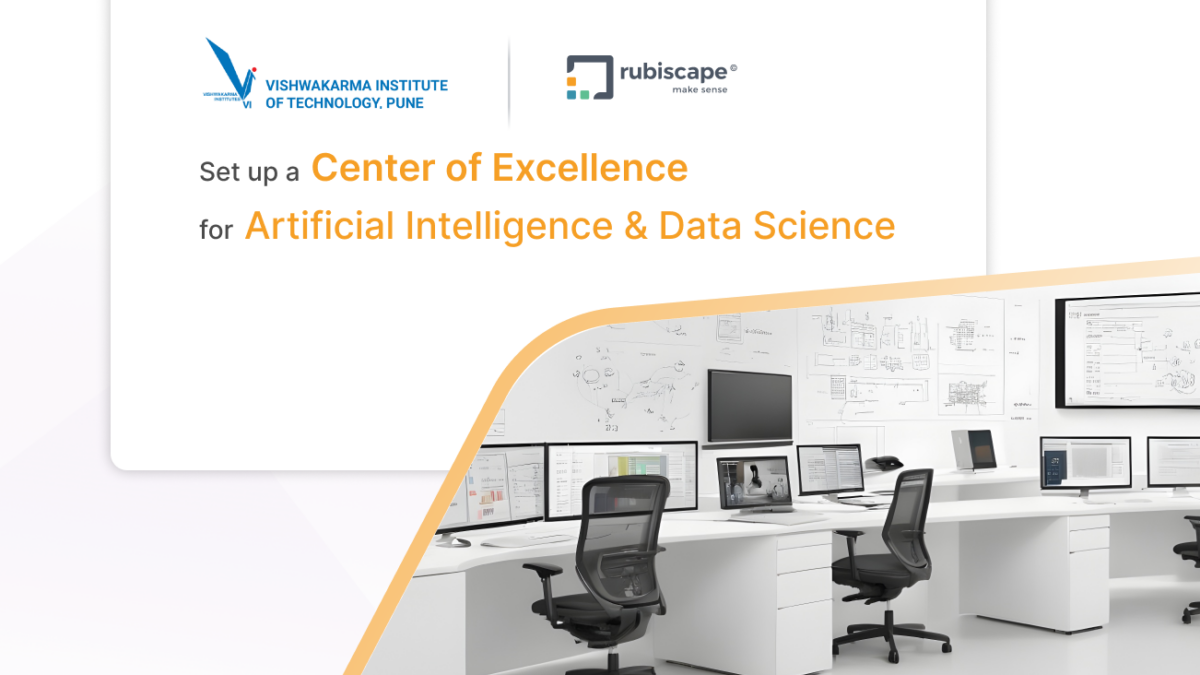
Leading Engineering Institute VIIT and Rubiscape set up a Center of Excellence for Artificial Intelligence and Data Science on the National Technology Day

On the occasion of the National Technology Day, Vishwakarma Institute of Information Technology (VIIT) Pune has inaugurated a Center of Excellence (COE) for Artificial Intelligence and Data Science (AI-DS) at their University along with Rubiscape, India’s first unified Data Science platform company. The COE was inaugurated by Dr. Hemant Darbari, The National Mission Director of The Super Computing Mission and Ex Executive Director of C-DAC in presence of the Chief Executive Officer of Rubiscape India Dr. Prashant Pansare, Mr. Bharat Agarwal, The Management Trustee of The VIIT & President of Vishwakarma University, Dr. Vivek Deshpande, Director at VIIT and Mr. Kedar Sabne, Director of Rubiscape, Dr. Parikshit Mahalle Head AI-DS at VIIT, Dr. Atul Kulkarni and Prof. Vivek Patil other VIIT team members. This state-of-the-art COE that has Rubiscape AI-DS technology applications that are truly made in India, and run on the HP & Nvidia High-Performance Computing Platform along with the cloud and open source technologies. The COE will focus on promoting technology R&D, knowledge creation, competency development, innovation incubation, and research fellowships in the field of AI-DS. VIIT hosted a knowledge symposium in pursuit of excellence in AI-DS with the theme – The National Super Computing Mission and was well attended by the students from engineering and management streams along with the industry delegates at the VIIT campus in Pune. Speaking at the symposium Dr. Hemant Darbari said, “India has gained substantial momentum in supercomputing mission. CDAC has designed and developed an India’s first indigenous HPC platform called ‘Rudra’ and ‘Trinetra’ a next-generation indigenous HPC interconnect, to meet the HPC requirements of all governments and PSUs as well as the strategic needs of the country in areas like oil exploration, flood prediction as well as genomics, and drug discovery. There is a good potential for AI-HPC in India in coming years and Data Science applications like Rubiscape will be useful for developing AI-as-a-service solutions for the global markets.” “The 21st century is ruled by the digital and data; it is turning out to be the ‘oxygen’ of this technology-driven era. We are excited to partner with VIIT by empowering the Indian aspiring Data Scientists in their career pathways”, said Dr. Prashant Pansare CEO of Rubiscape.  He further added, “Rubiscape-VIIT Centre for Excellence in AI & Data Science; that aims at future-skilling, fostering a culture of innovation, product incubation and start-up acceleration. Rubiscape’s low-code Data science platform running on HP & Nvidia powered HPC workstations provide a reliable and scalable compute power for handling the massive workloads and complexities for AI-ML processing. We are excited with the possible opportunities for Made-in-India innovation for the world”. Mr. Bharat Agarwal the Managing Trustee of VIIT speaking at the program said, “­­­­­­­­­­Past few years were tough, but now with the campuses re-opening we are starting a fresh. VIIT has been countries one of the leading institutions and we are committed to provide a world-class facility and faculty to our students across multiple disciplines. Our newly inaugurated Rubiscape-VIIT Centre for Excellence in AI & Data Science will enable our students and industry partners advance with an Innovation Agenda. Rubiscape-VIIT Centre also will offer specialized and value-added courses to the students and industry executives.” “VIIT DS-AI COE will offer specialized programs in Data Science and Business Analytics and will strive to develop a talent pool from across the country, which will provide cutting-edge solutions to meet the industry’s emerging and future requirements”. said Dr. Vivek Deshpande, Director VIIT. VIIT has designed our programs to help students apply analytical skills to every aspect of business analytics. It lays a heavy emphasis on corporate partnerships through digital education research internships, industry connects to apply their knowledge to real-world problems through case studies and live projects. VIIT is launching an innovation incubation centre soon. About VIIT Vishwakarma Institute of Information Technology (VIIT) was established in 2002 by Bansilal Ramnath Agarwal Charitable Trust (BRACT), Pune, Maharashtra, in order to produce engineering graduates capable of accepting challenges in the new environment of technical advancements. VIIT has developed into an institute recognized amongst few top-ranking engineering colleges in Pune, Maharashtra, India About Rubiscape Rubiscape is an award winning, futuristic, versatile, low code, hyper-scalable and all-in-one platform Data Science. Designed for easier and effective – Artificial Intelligence Rubiscape offers integrated toolsets for – Machine Learning, Video Analytics, Data Visualisations, Location Intelligence, IoT and EDGE Analytics. Rubiversity– an EdTech arm of to partner with universities offering a blended eLearning platform (software + courseware) for a joint certification. Rubiversity enables institutions to set-up   innovation incubation, and centre of excellence for AI & DS technologies.  

Other

Top Mistakes Made by Data Scientists

Data Science helps businesses gain actionable insights from various sources of structured and unstructured data by applying scientific methods, processes, and systems. It requires a proper understanding of the different techniques used for preparing the data and knowledge about various data models that may be used to finally measure the outcome from the full process. In this entire cycle, there may be numerous factors that may be overlooked even by the most seasoned data scientists. Through this article, we share some of our insights on some of the most common mistakes made by data scientists.   Growing demand for data scientists and their role in the information age According to a recent survey made by KMPG on C-Level executives, 99% of them affirmed that big data would be a core part of their company’s strategy in the coming year. It’s believed that enterprise data will exceed by around 240 exabytes per day in 2020, which will create a greater demand for data scientists with key skills for extracting actionable insights from data. A striking example is that of the popular social networking site LinkedIn where data scientists have played a vital role in boosting business intelligence for the company. LinkedIn relies mainly on the data that is transferred by its 3,80,000 users who have built connections with each other. LinkedIn is utilizing the skills of such professionals to explore the world of Big data. Apart from LinkedIn, other big names such as Google and Facebook are utilizing the role of data scientists to give a better structure to large quantities of formless data to help them establish the significance of its value and bring a standard relationship between the variables. Most of the data architects extract information through large volumes of data and use SQL queries and data analytics for slicing these datasets. On the other hand, data scientists have a larger role to play as they need to have advanced knowledge of machine learning and software engineering to manipulate the data on their own to provide deeper insights. They mainly use advanced statistics along with complex data modeling techniques to come up with their future predictions.   What are the common mistakes made by data scientists? Failure to address the real questions The entire process of data science revolves around addressing the business questions and in most cases, it is the most neglected issue due to lack of communication between the sponsors, end-users, and the data science team. To get the most benefits from the data science initiatives, all the stakeholders need to stay connected and share information and knowledge which can help in defining the real business issues. Beginning with excessive data In many companies, the team members are involved in working on a huge chunk of data which is a waste of valuable time and effort. Instead, it can be more worthwhile for them to choose a subset of specific data to make the process much easier. For example – Is it possible to focus on just a single region or look for data from the last three months? To start with the prototype, random sampling may be taken into consideration. When the initial exploration, cleaning, and preparation are done, a bigger data set may be included in the process. Trying to complicate things Sometimes, even if the current project requires a simpler solution, data scientists often make the mistake of complicating matters by introducing more complicated models into the process. This can jeopardize the chances of completing the project on schedule and make it more difficult to achieve the main purpose. Not validating results The models that are created by the team of data scientists should enable the business to take suitable action. And once an action has been taken, it’s necessary to measure its effectiveness for which the team needs to have a validation plan ready, even before the actual implementation. Only this can help in making the process more efficient and give more meaningful results. More focus on tools than on business problems The major function of any data-driven role is to focus on solving problems through data extraction, but sometimes, the data scientists get overwhelmed and obsessed with using new tools than solving the real issues at hand. They need to understand the problem first and find out the requirements for finding the solution and finally decide on the best tools that may be used to solve the problem. Lack of proper communication There is plenty of communication involved in assessing the business problem and providing constant feedback to the stakeholders. The greatest risk comes when the data scientists do not ask enough questions and make their assumptions, which actually can result in providing a different solution than what is required.   The Key Ingredients of Data Science Data science requires knowledge of Statistics and Applied Maths Data science requires actual application of Statistics along with Applied Maths, which can provide guidance regarding uncertainty in data and allow companies to gather valuable insights from it Data Science involves solid communication A data scientist needs to be an effective team player who helps to initiate, iterate and drive some core decisions in the company. The role of a data scientist involves working along with product managers and the other team members to influence them to take vital business and product-related decisions. Data Science is about using creativity and dealing with people Data scientists need to have a creative approach as they need to understand the needs of the users in the system and convey their findings to the other core members of the team. At the same time, they need to be creative enough to derive insights from the system that generated the data in the first place. In this age of Big data, the biggest challenge will be on collecting data and extracting value from it which will get more demanding in the coming years. Data Scientists will have a key role to play in shaping the economy of the future by

Other

The Connected World of Tomorrow Powered by Data

The world today is connected aggressively. Networks, devices, systems, processes, and humans- everything is bound by data. And as the quote goes, “Data is a precious thing and will last longer than the systems themselves”, today’s hyper-connected world is fueled thoroughly with data and has an impact on every single action and decision that humans take across the globe. No longer confined to any particular tech or industry, data has helped revamp global operations across diverse industries and has significantly transformed the ease of living and day-to-day living. But how is this new and connected world of tomorrow powered by data? What implications will it have on the way people live, and businesses operate? Will there be unforeseen challenges that can convulse the data-driven world, or are we ready to take on the hurdles? Let’s discuss… All roads lead to…data Data collection has been one of the attributes of modern civilizations and has been existent for a long time, but never has been as important as it is today. What started with simple data markers that were not interconnected, Big Data evolved as an all-knowing, all-encompassing umbrella that holds enormous amounts of data that is precious for several industries and sectors. Manufacturing With Industry 4.0, the importance of data has been aggrandized and data is essentially the driver of the key components – from risk assessment, supply chain, maintenance to sales. From Big Data to AI-powered tools, from cloud manufacturing to smart factories, data is flown through and collected via several diverse elements of the manufacturing industry where digital transformation is deeply penetrated. Big Data brings in operational transparency, helps in strategic decision making, helps in offering bespoke solutions tailor-made to suit the customer requirement based on previous purchase preferences, and significantly helps in improving the overall product quality. Naturally, this further leads to better after-sales service, operational efficiency with detailed tracking of employee and machine productivity, close monitoring of logistics, and predictive maintenance and support. Automotive The automotive sector has undergone a huge revamp in recent years, primarily to suffice the industry’s growing needs and balance the fossil energy deficit. The automotive industry is largely moving towards electric cars or autonomous/self-driven cars that are most certainly the future of automotive. Modern cars are heavily connected to other interconnected systems, such as home automation and IoT devices powered by data. The large amounts of data collected from IoT based sensors in cars are important to enhance the driving experience, offer the latest traffic and weather stats, streamline insurance in case of incidence, provide predictive maintenance to avoid on-road failure, and reduce accidents and improve the safety standards of the car. Healthcare The Healthcare industry is immensely data-driven. Data in healthcare has been incremental in maintaining a 360-degree view of patient data, offering predictive modeling and analysis, extending preventive healthcare, and using the data to treat large subsets of the population in a particular geography. Connecting patient data with employee data can also help organizations in the healthcare sector achieve their business goals, align necessary care with optimized resource planning, and further improve the patient experience. Banking The banking sector, although highly organized across the globe, has been hesitant when it comes to a complete digital overhaul. While the financial sector has been welcoming to the change caused by digital transformation, the conventional banking sector has taken slow and steady steps into implementing data-powered tools while ironically, they have a vast amount of precious customer data that is documented to perfection. Banks that are making wide use of this data can create a more immersive customer experience powered by Artificial Intelligence and Machine learning. Cognitive banking involves the use of robotic and automotive AI to execute, process, and implement data to improve the overall digital banking experience. From customer communication, selling and upselling of financial products, to building a loyal customer base, data can do wonders to the banking sector, when tapped into with precision. Energy Reducing energy consumption, optimization of non-fuel resources for energy generation, refining energy efficiency, and offering consistent energy with minimum power outages are the key benefits of Big Data, IoT-powered sensors, and other data-driven technologies used in the energy sector. The growing demand for smart cities further highlights the importance of data in the energy sector. India alone has deployed more than 1500,000 smart meters. The rate of adaptation of smart metering and smart grid systems is also increasing across China – two countries with the largest populations in the world. Big Data Analytics has been immensely powerful in smart metering, which helps forecast the energy consumption to manage the demand against the supply and reduce energy wastage. The world of tomorrow is truly expected to be connected with data breathing life into it. However, this interconnected world of data and the companies that drive this data-powered innovation are met with several challenges, which, if not mitigated, can cause more harm than good. Let’s discuss… Challenges of the data-powered world and the role of data science platform Data quality We all agree that data is gold, but when collected in copious amounts, there’s no denying that there are tons (virtual) of junk, unusable, and uninterpretable data. Dirty data or data with substandard quality, which can be inaccurate, incorrect, duplicate, inconsistent, incomplete, or data that has violated rules and compliance, can create complexities for the systems that are data-dependent. Maintaining data quality based on user requirements or organizational framework is a real challenge and can only be mitigated with data profiling, data annotation, and analysis to continuously make the data readable and usable. A data science platform can be critical in data cleaning, quality investigation, and maintenance and is crucial for the data to work the wonders it can. Data integration and transformation Inconsistency in data collection can cause challenges related to data integration when companies depend on more than one source for data collection. Raw data needs to be normalized before it can be accessed by data-powered systems and be meaningful enough to drive any insights.

Scroll to Top