Author name: Rubiscape Team

Other

Data-Driven Lean Manufacturing: How to Apply Data Science for Continuous Improvement

The convergence of data science and lean manufacturing principles has paved the way for a revolution in how industries optimize their operations and enhance productivity. In fact, the global digital lean manufacturing market has experienced staggering growth in recent years. The market commanded an estimated worth of $23.99 billion in 2025; it then swiftly expanded further to reach$26.86 billion in 2023. There’s no doubt about the manufacturing industry’s commitment to lean principles. However, refining these processes by infusingdata science techniques is an intriguing proposition altogether. What Exactly Is Lean Manufacturing?   Lean manufacturing represents a production and management philosophy. This approach has found application across diverse industries, with its primary objective being waste reduction while concurrently enhancing efficiency and customer value. The principles that underpin this system trace back to those initially presented by Toyota during the 1950s–1960s. Thus, Lean is also occasionally referred to as the Toyota Production System (TPS). Key concepts of lean manufacturing include: Value: Value is assessed from the customer’s point of view and is related to how much they are willing to pay for goods and services. Value Stream: A value stream is a product’s whole life cycle, which includes the design of the product, its usage by consumers, and its disposal. Flow: Lean manufacturing is the practice of simplifying processes and procedures in order to decrease waste and, hence, enhance output. Pull: Lean manufacturing is built on a pull system, which means that nothing is purchased or manufactured unless there is a need for it. Perfection: Lean manufacturing stresses the idea of always striving for excellence, which requires identifying and removing the core causes of quality issues via continuous improvement, or “Kaizen.” How Does Data-Driven Decision-Making Enhance Lean Manufacturing?   Data-driven decision-making is critical to improving lean manufacturing as it relays important insights and allows for better-informed choices throughout the manufacturing process. This is accomplished in the following manner: Improved Visibility & Real-time Monitoring   About 57% of enterprises employ data and analytics to drive strategy and change. Another 60% of companies worldwide use analytics to drive process and cost-efficiency. Manufacturers can leverage real-time insights into their production processes through the use of data-driven tools and technologies. They collect and analyze data from sensors, machines, and other sources to monitor operations at a granular level. This approach provides businesses with real-time visibility that aids in identifying bottlenecks and anomalies. Areas where efficiency can be enhanced are also brought to light. Performance Metrics   Manufacturers track a range of metrics: Overall Equipment Effectiveness (OEE), takt time, lead time, cumulative flow, and defect rates — to name just a few. All these metrics play well into ensuring a lean operation. By providing valuable insights into process efficiency and product quality, these metrics act as critical tools for gauging operational effectiveness. Manufacturers, through the analysis of historical performance data and its comparison to current results, can pinpoint areas for improvement. Demand Forecasting & Inventory Management   Accurate demand forecasting is a cornerstone of lean manufacturing. According to aMcKinsey report, applying AI-driven forecasting to supply chain management can, in fact, reduce errors by between 20% and 50%. When such forecasts combine with inventory management systems, manufacturers gain the ability to align production directly with real-time customer demands. This helps: Minimize the costs associated with overproduction and excessive inventory. Ensure not only product availability but also responsiveness to altering market demands. How Can Enterprises Drive Data-Driven Lean Manufacturing?   Enterprises can successfully carry out data-driven lean manufacturing by embracing a culture of continuous improvement. Here are four crucial components to accomplishing this: Efficient Data Processing   By processing and analyzing data from sensors, machines, and other sources, manufacturers can uncover patterns, trends, and anomalies that might go unnoticed through traditional methods. For that, they need to establish a concrete technological framework that helps: Aggregate pertinent data from various data sources, such as data lakes and warehouses Preprocess data so that it can be cleaned and brought into a structured format Transform data into machine-readable form so that it can be sent to the processing unit Processes data using AI/ML algorithms to deliver the suitable outcomes Present the data in a readable format, such as via graphs or tables Data Visualization   Continuing from the last point, it bodes well for manufacturers to invest in user-friendly dashboards and data visualization technologies that convert complicated data sets into easily understandable visual representations. Employees at all levels of the company, from shop floor operators to top-level management, may benefit from visualization tools to get insights into production performance, quality measures, and key performance indicators (KPIs). Citizen Data Science   Encouraging a “citizen data science” culture within the firm can enable employees to actively participate in data-driven lean manufacturing projects. Citizen data scientists should be able to examine data and develop relevant conclusions with the help of training and tools provided by businesses. This democratization of data analysis can potentially make production nimbler and more responsive. Multi-Persona DSML Platform   All the above components are dependent on the data analytics platform that an organization has employed for informed decision-making. This is where the adoption of multi-persona data science and machine learning (DSML) platforms gains importance. These platforms cater to both vertical and horizontal use cases, bring non-technical users to the mix with low-code capabilities, offer a holistic view of operations, and drive robust governance andcollaboration. The Rubiscape Advantage   In the quest for data-driven lean manufacturing, multi-persona DSML platforms, likeRubiscape, offer the tools and insights you need to transform your operations, reduce waste, enhance quality, and adapt swiftly to changing market dynamics. From refining data processing and visualization to empowering citizen data scientists, it’s time to explore the future of manufacturing efficiency with cutting-edge data science capabilities!Schedule a demo today to learn more.


Other

Data-Driven Enterprise – What, Why, And How

Being data-driven is a good idea for businesses looking to optimize their assets and growth prospects. In fact, it is fast becoming a widely-accepted system to improve the day-to-day workflow management. Organizations want to be data-driven – they want to be guided by data. While there is a massive amount of data being gathered, simply “having data” does not make one a data-driven organization. It needs to be much more than that. There are several aspects to a data-driven enterprise. Today, let me talk more about those. What Is a Data-Driven Enterprise? Simply put, any business which makes use of analytics to arrive at decisions is a data-driven enterprise. Of course, it’s not as easy as it seems. But basically, they use data for strategic decision-making. Now, what kind of data is it? It is reliable, relevant, accurate, replicable, and has all the other necessities to be called solid, quality data. In one of my earlier posts, I had written about data scientists. They play a huge role for a business to become data-driven. If they are able to provide worthy data, more than half of the task of becoming a data-driven enterprise is already achieved. Why Is It Necessary? Data-driven enterprises can easily tackle a whole lot functions thanks to their analytical decision-making ability. A paper published by MIT’s Sloan School of Management states that data-driven decision-making results in 5-6% higher productivity and output, for a business than its investments in information technology and more like those. Being data-driven, businesses can keep an eye for prospective clients as they have an upper hand at knowing the inside market conditions. This helps set the company apart from its competitors and gives it an image of one which is well informed, competitive, and reliable. Needless to say, it also assists in serving the existing customers since they are better understood and hence, served even before they raise their concerns. That is the power of quality data. It provides a business with such smart details that every department can benefit from it – right from Marketing to Finance to R&D – enabling the business as a whole to make an in-depth analysis of market conditions and eventually even predict market trends. How to Become a Data-Driven Enterprise? Using the right tools is a prerequisite for this objective. However, even before selecting the tools, it is imperative to develop a strategic plan of the objectives the business wishes to achieve. Accordingly, then, the tools need to be decided. For example, Warby Parker, a retailer of prescription glasses and sunglasses, was initially using Excel for computing the key metrics. However, as the company grew, it became virtually impossible to collate the regularly increasing humongous amount of data. Their analysts finally shifted to using MySQL relational database. This helped the company immensely to continue producing an in-depth analysis of the data procured. Second, it is important to adopt data and analytics across all levels in the company by having data-led practices. It actually means sharing vital information with fellow colleagues so that everyone together benefits from the varied bits and pieces received from a chunk of data. Unless and until data flows from various hierarchies in a business, it might not be possible to gain the real positives of becoming a data-driven enterprise; having only a couple of departments using analytics to function will never do any good for achieving the final targets of the business plan. Third, train the staff on using data in their daily work place. Once everyone has access to the data which is relevant to their department, the overall productivity of the business is bound to increase. Take this for an example. Sprig, a food-delivery company in SFO, uses an analytics platform. Now, even their chef has access to this data to study what kind of meals are popular, which ingredients or flavors are more preferred, and then use this information to plan the menus! Imagine the benefits the company reaps thanks to not just by being data-driven but by training its staff to use the data at hand. Before I conclude, I would like to make a very important point here. Being data-driven does not mean only having a set of systems or practices which make use of some xyz data to function. It also involves having a daily work culture which believes in functioning analytically. When everyone on board believes in the results of good, quality data, it will show through all their individual actions. Thus, every employee of the business, right from its head to the accounts person to the marketing trainee needs to get involved in the process and apply the data-driven systems to fine-tune their productivity. Linkedin X-twitter Facebook

Other

How Big Data and Analytics Can Transform the World of OTT

We are truly steeped deep in the age of the customer, where ‘choice’ is the recipe for success. When it comes to entertainment and video, the case is quite the same. The rise of high-speed internet and the proliferation of the smartphone culture has completely changed the way we consume content. Once ‘cable’ dependent, today, we are no longer hostage to a cable or broadcaster. This is all thanks to the rise of ‘Over The Top’ or OTT channels where content is delivered through an internet connection. With services like Netflix and Hulu as a regular part of our vocabulary, the OTT market is all set to explode. Research shows that the OTT market and VoD (video-on-demand) market in the APAC region, for example, is estimated to sit at $42Billion in revenue from 351mn subscribers by 2023. Broad content offerings made the OTT industry achieve its popularity. However, today just broad-based content offerings are no longer enough. Personalization has taken up its place at the heart of streaming services. “To succeed in this brave new video world, you need an alchemy of attractive content, an appealing user experience, the opportunity for personalization, an integration of data and technology, and some early credibility in the existing business ecosystem.” – Howard Homonoff, Digital Media Strategist and Business Transformation Advisor. Today broadcast media companies are going on the OTT mode and are delivering video content to their subscribers via multiple channels. As the OTT market matures, it also gets more competitive. For instance – Customer churn is one of the greatest challenges for OTT businesses Ensuring the highest customer lifetime value out of the customer base is difficult With more providers entering the market, OTT providers have to come up with ways to get their customers to stay with the service after the initial viewing experience and get them to become avid customers The answers lie in big data and analytics. In fact, Dave Hastings, Netflix’s director of product analytics, explicitly stated that “You do not make a $100 million investment these days without an awful lot of analytics”. How big data and analytics can change the world of OTT    The key to a great OTT service starts with an understanding of the customer and responding to their needs promptly – whether it is for content, the user experience, or the business model. Since the ‘viewer’ lies in the heart of the business, OTT managers have to look at big data and analytics to enable actionable learning of customer behaviors and manage business rules. Understanding customer churn   OTT viewers today are spoilt for choice. The market is getting overcrowded. Along with the number of OTT players, the choice of providers is also increasing for the customer. Customer churn is a real problem to solve to maintain profitability in the OTT universe. Most OTT services struggle with retention once they launch. Customer acquisition is also becoming more expensive and challenging as markets become more populated. However, big data and analytics can level the playing field here by providing detailed churn analytics that answers questions like ‘which customers are most likely to churn next month’? Big data analytics gives OTT providers the capacity to aggregate disparate data sets and develop a 360-degree customer view. OTT providers can use more-accurate churn prediction models and use real-time and historical data, user data and user behavior, and other associated data to identify subscriber clusters with a high risk of churn. They also get detailed insights into the main causes of churn and can proactively take measures to solve this problem. Crossing the content chasm with personalization                Personalized, relevant, and contextual content is what OTT viewers demand. OTT has now become mainstream, and the viewers want a lot of content on multiple services. However, with new streaming services that come online almost every other week, there is more content today than ever has been produced in history. The recommendation engines need more customization and personalization powers to deliver the right content to the users. OTT content needs to leverage big data and analytics to get to that ‘Spotify’ model where content can easily be served based on individual preference. By combining large data sets of user data and metadata for analysis, OTT providers can fine-tune their recommendation engine and ensure that the right content reaches the right user. Deep big data analytics also gives OTT providers deeper audience insights. It helps them understand genres of content that are in high demand, what content the audience demands at what time of the day, when do they pause, or what do they skip. Based on this data, OTT providers can make informed decisions on content dissemination. Improve customer experience   Understanding territory-specific nuances of user behavior and gaining insights into device demographics and platform infrastructure becomes essential as OTT providers look at wooing international audiences. Additionally, gaining granular insights into real-time across live and on-demand services also becomes essential to improve customer experience and stay on top of the OTT game. Big Data and Analytics play a significant role in providing deep insights into all the influencers of customer experience by looking at all the data intelligence. Analytics helps in getting a complete and multi-dimensional understanding of viewer experience and gives OTT providers information granularity to benchmark things that matter most, identify disruptions that impact engagement, and make smart business decisions without ambiguity influencing it. Using behavior-based audience insights and fan analytics enables OTT providers to profile the viewers accurately. This helps them make more informed business decisions on programming choices, marketing effectiveness, predictable cross-selling, and upselling opportunities, making it more relevant and contextual to the viewer. In Conclusion   Big Data and Analytics are transforming the world of OTT by enhancing the user experience through more accurate and personalized recommendations. It allows for advertising to become more targeted based on user preferences. Big data and Analytics also give insights into making more accurate predictions on the next best offers and help

Eviden & Rubiscape Partnership
News

Rubiscape is selected in a Scaler Program by Eviden, an Atos Company

    Artificial Intelligence, Blockchain and NetZero (Read on Evidan Website) Paris, France – October 20, 2023 – Eviden, the Atos Group business leading in digital, cloud, big data and security today announces the integration of 3 new start-ups into Scaler, its acceleration program dedicated to open innovation for young start-ups and SMEs. With this program, Eviden supports the development of their activities, encourages their international growth and gives them access to the Group’s customers and its ecosystem of partners. Specialists in Artificial Intelligence / Machine Learning, Blockchain and NetZero, these new recruits bring pioneering expertise that promises to enrich Eviden’s already flourishing ecosystem. Their integration into the Scaler program will strengthen the Group’s ability to inject innovation into the projects that it runs with its customers, broadening its impact in the industry. Launched in 2020, the Scaler program has already supported 27 start-ups. Over a period of 24 months, Eviden’s teams have worked with these start-ups to define the best joint value proposition before giving them access to their international customers and major strategic partners. The Scaler program recently led to the signing of a contract between Eviden and ColibrITD, for the creation of the first hybrid quantum computing platform dedicated to combustion, in partnership with the French institution ONERA. New start-ups in 2023: Rubiscape: With the exponential demand for artificial intelligence and pressing time-to-market expectations, start-ups that offers AI solutions that are more efficient, and deployable more quickly and easily are high-profile gems. Rubiscape’s multi-persona low-code Data Science and Machine Learning (DSML) platform offers a set of integrated tools to simplify AI solutions while providing visual analysis summaries, helping to meet business challenges and accelerate the implementation of even the most complex and ground-breaking projects. Rubiscape enhances Eviden’s existing AI offering and is applicable to all industry sectors. Rubiscape is also part of the start-up programs of Eviden’s partners AWS, Google Cloud and Microsoft. It has received numerous international awards, including the NASSCOM DeepTech Club Start-up and Aegis Graham Bell Award for product innovation. About Eviden Eviden is a next-gen technology leader in data-driven, trusted and sustainable digital transformation with a strong portfolio of patented technologies. With worldwide leading positions in advanced computing, security, AI, cloud and digital platforms, it provides deep expertise for all industries in more than 47 countries. Bringing together 55,000 world-class talents, Eviden expands the possibilities of data and technology across the digital continuum, now and for generations to come. Eviden is an Atos Group company with an annual revenue of c. € 5 billion. About Atos Atos is a global leader in digital transformation with 107,000 employees and annual revenue of c. € 11 billion. European number one in cybersecurity, cloud and high-performance computing, the Group provides tailored end-to-end solutions for all industries in 69 countries. A pioneer in decarbonization services and products, Atos is committed to a secure and decarbonized digital for its clients. Atos is a SE (Societas Europaea), and listed on Euronext Paris.

Pune University and Rubiscape offer a program on "Artificial Intelligence and Machine Learning
News

Pune University and Rubiscape to offer an Education Program on “Artificial Intelligence and Machine Learning”

In the frame:  From left – Dr. Aditya Abhyankar (HOD, DOT, SPPU),  Shri. Ravindra Shingnapurkar Management Council Member, SPPU, V.C. Prof. Dr. Gosavi (Vice Chancellor, SPPU), Dr. Prashant Pansare (CEO Rubiscape) and Gauri Bapat (Director Strategic Business). Savitribai Phule Pune University (SPPU) has signed a Memorandum of Understanding (MoUs) with Rubiscape India, as part of the New Education Policy’s (NEP) push to develop ‘Artificial Intelligence and Machine Learning’ education program, skills development for employability, innovation incubation and research & development. SPPU along with Rubiscape is jointly offering a One Year Post Graduate Diploma in Artificial Intelligence and Machine Learning, through its AI-DS Application Lab at the Department of Technology. The Vice Chancellor Dr Gosavi in his comments said – “ An education program of this stature draws students from across the globe, creating diverse learning environment. As AI technologies become more powerful, ethical considerations become paramount hence taking a proactive stance on fostering ethical AI Development is the need of the hour. This collaboration with Rubiscape ensures that students understand the ethical implications of their work and are equipped to design AI systems that align with ethical practices. “ Dr. Prashant Pansare – Founder & CEO of Rubiscape India said – “In this era, software writes itself and machines learn, AI will revolutionize every industry. There is a growing demand for AI-ML skills, and India certainly has a potential to become a global AI talent supplier. We are excited with our indigenous technology platform to partner with Pune University in crafting and offering a well-designed course, keeping the future-skills and innovation agenda in mind.” He further added, “All the vital elements of the New Education Policy are well mapped in this course, and will be supplemented by industry mentoring, innovation challenges, knowledge networking throughout the year”.    Rubiscape was established under Digital India Start-up Program, and has been partnering with many leading enterprises, public sector, defence as well as state government clients. SPPU will onboard Rubiscape – Data Science Technology in undergraduate/graduate curriculum for training of students and faculty members and also in R&D projects to promote local and low-cost solutions for the global markets. The course will be launched in the current Academic year. Prof Dr. Aditya Abhyankar, Head of the Department of Technology SPPU said – “What sets this program apart is its industry-relevant curriculum. By collaborating with Rubiscape the program ensures that students gain practical insights and hands-on lab experience. Candidates will be well-prepared to tackle real-world challenges and contribute meaningfully to advancements in these fields. AI and machine learning has transitioned the traditional academic boundaries. This program adopts a multidisciplinary approach, attracting candidates from various backgrounds such as computer science, engineering, mathematics, and beyond. This diversity of perspectives enriches the learning experience and mirrors the collaborative nature of AI development, he added.” About Savitribai Phule Pune University, one of the premier universities in India, is positioned in the western part of Pune city. It occupies an area of about 411 acres. It was established on 10th February 1949 under the Poona University Act. The university houses 46 academic departments. It has about 307 recognized research institutes and 612 affiliated colleges offering graduate and under-graduate courses. Know more – www.unipune.ac.in About Rubiscape Rubiscape is a truly unified Data Science Software Product. Rubiscape brings to you a Data Science Lab-in-a-Box to connect, analyse, model, deploy, visualize your diverse data in one powerful platform. (Watch a Product Tour) Many forward-thinking enterprises run Rubiscape that has won several awards and accolades. Rubiscape has established AI-DS Labs and COEs at leading institutions for Future Skilling Programs, Innovation Incubation, PPP Projects. Empanelled as a software OEM on GeM portal and is an ISO & ISMS Certified Company Know More – www.rubiscape.com

Other

From New Product Design to Customer Experience (And Everything in Between)

  According to a BCG report, 72% of manufacturing companies are improving their productivity using advanced analytics. Today, the applications of data science have become pervasive.    Industries like finance, healthcare, and customer service are jumping onto the bandwagon, and rightly so. After all, data science gives them the ability to improve real-world use cases. For example, they can augment their industry knowledge, create a human-centered design framework, inform UX processes, and much more when designing products.   Customer-centric companies use data science to understand customer behavior, make real-time business decisions, reduce human error, and negate adverse business outcomes.   That said, here’s a look at 10 business areas most influenced by data science. 1. Customer Service Happy customers are the cornerstone of every business. Data science enables businesses to understand their customers better and provide exceptional service. For instance, data science tools can be leveraged to improve customer service by: Collecting and analyzing customer data for business insights Identifying customer trends and patterns Predicting customer behavior Developing customer self-servicing methods   Additionally, through regular customer feedback, companies can gauge customer satisfaction levels and rectify problems, if any. 2. Finance Data science is an integral part of the modern banking and finance industry. On its part, the finance industry generates massive volumes of data — most of which goes unutilized.    Data science tools in the financial domain are used for a variety of use cases like fraud detection and designing personalized services for individuals.   To that end, the top data science applications in the finance domain include: Data-based risk analytics to understand the scope of financial risks Real-time analytics on historical financial data of any company or entity Consumer analytics to personalize financial products for individual customers 3. Human Resource With the growing labor shortage, employers are struggling to attract and retain talent across industries. Data science-based HR analytics tools can help employers make improved workforce decisions and enhance work productivity.    For example, data science can help HR teams carry out employee sentiment analysis and accordingly redesign their HR policies.    Similarly, data science tools can measure the effectiveness of employee training programs and customize workforce development initiatives for a better future.    Predictive analytics in the recruitment process can further improve the talent acquisition process based on historical data. 4. IT Compliance Companies that collect customer data must adhere to regulations regarding data security and privacy. Without IT compliance, organizations are most likely to face violation-related penalties and fines.    Favorably, organizations can leverage data analytics to check if the collected data is compliant with industry regulations. For example, they can: Structure compliance-related data for high-quality and governance Understand IT compliance-related risks Improve internal compliance-related procedures and processes   With data-driven compliance, companies can now avoid a variety of non-compliance risks, such as internal fraud, ESG risks, and corruption. 5. Management With data-driven solutions, companies can also improvise their business management and achieve their business goals. Effective management analytics can support and influence business decisions with accurate insights.    At its core, a data-driven organizational culture enables efficient collaboration among multiple stakeholders, including product teams, project managers, and shareholders.   Further, data science skills enable potential business leaders to include data-driven problem-solving abilities in their daily work. It helps management teams arrive at smarter decisions based on the existing business data. 6. Marketing Data science in marketing is enabling companies to analyze their customer’s needs and provide them with personalized offerings. For example, companies like Spotify and Amazon can recommend content based on each individual’s previous interactions.   Besides providing recommendations, data science has multiple use cases in marketing, including: Performing sentiment analysis on customers’ posts and feedback on social media pages Developing a customer churn model to analyze the customer’s pain points and ways to retain users Segmenting customer profiles into various subgroups and targeting each group with personalized marketing Designing or improving products that can meet customer needs and solve their problems 7. Procurement Effective cost management is the top priority for procurement teams post the COVID-19 pandemic. The 2020 Deloitte survey concludes that procurement leaders must be resourceful about cash management while limiting supply-related disruptions.    As it stands, data science technology can streamline procurement activities and increase efficiency.   Data-based procurement analytics can analyze real-time procurement data for accurate business insights. Here are some of the benefits of data science in the procurement process: Improved budgeting and forecasting Improved risk mitigation and disruption management Effective contract management and discounting with approved vendors Improved benchmarking of procurement performance based on item category, quantity, and country 8. Quality Be it manufacturing or healthcare, high-quality products or services are creating new market opportunities for organizations. And data science has a significant role to play here.   Besides improving decision-making, quality-related data enables organizations to cut costs and improve their products or services.    For example, data-driven quality control can help companies detect issues at an early stage, thus avoiding the high costs of product recall or rework. Additionally, quality control enables companies to identify operational risks and improve their overall inspection process. 9. Sales Data science technology can improve customer satisfaction, which in turn, leads to higher sales. Besides, by gathering and analyzing customer information, data science provides sales teams with more cross-selling and up-selling opportunities.    McKinsey reports that 72% of the fastest-growing B2B companies plan their sales using data analytics as compared to 50% of the slow-growing companies.   Data science in sales enables organizations to: Maximize the customer lifetime value (CLV) Predict future sales Prevent or reduce customer churn Identify cross-sell and up-sell opportunities Optimize their product pricing 10. Supply Chain Every manufacturing or distribution company must optimize its supply chain to prevent delays or disruptions. At the same time, they need to manage their supply chain costs.    Typically, supply chain operations involve a host of operations, including: Procurement of raw materials Inbound and outbound logistics Inventory management Order fulfillment   With data science tools, companies have real-time visibility into their supply chains and the ability to simulate possible scenarios. Additionally, they can leverage data-driven analytics to achieve business sustainability and optimize their

Rubiscape available on Azure Marketplace
News

Rubiscape Data Science Platform now available in the Microsoft Azure Marketplace

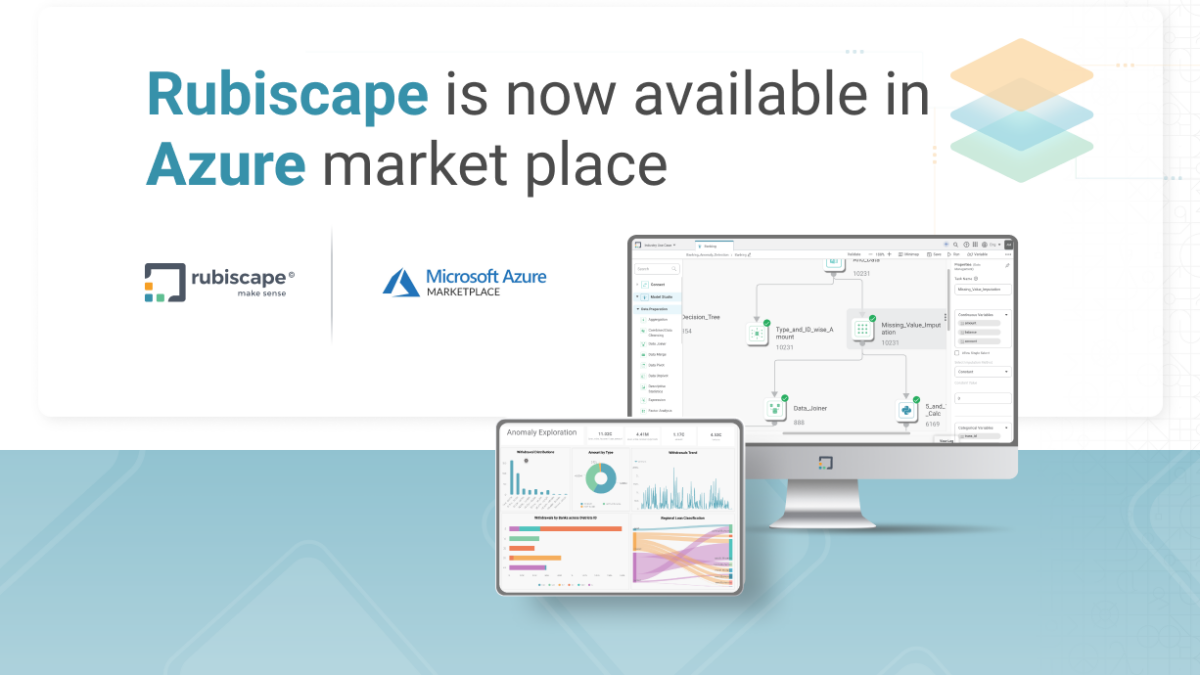
Microsoft Azure customers worldwide now gain access to Rubiscape Data Science to take advantage of the scalability, reliability, and agility of Azure for their data-driven innovation agenda. Wednesday, 19th July – Rubiscape, an award winning and a versatile platform for simplified AI and Data Science, today announced the availability of its flagship product – Rubiscape Data Science and Visualization Platform – on the Azure Marketplace, an online store providing SaaS applications and services. Rubiscape as well as Microsoft customers can now take advantage of the productive and trusted Azure cloud-based platform, with streamlined deployment and management. This is an era where the world is exploding with an enormous volume of data, it has become a real big challenge to effectively access, analyse, share, monetise this data into AI apps. Need of hour is – a tool that is unified, versatile and flexible yet simple, secure and scalable for AI-ML driven business models and applications and Rubiscape is just that. Rubiscape is a cloud-powered platform designed to create revolutionary Data Science experience with its Data-Scientist in-a-Box. Based on Azure Data Factory, IoT, with integration to Microsoft Teams, it provides a bridge between the online world and the brick-and-mortar world. Rubiscape turns data into AI apps that can be deployed across an enterprise, with no coding, with very less efforts, complexity, and costs. By deploying the Rubiscape enterprises can increase revenue, reduce costs by streamlining operations, and improve customer experience and loyalty. “We’re excited to continue to expand the capabilities of Rubiscape Data Science Suite as we work closely with Microsoft to leverage the efficiencies of the Azure Marketplace.” said Dr. Prashant Pansare, CEO of Rubiscape. “We are a step ahead in our mission of democratizing data. Rubiscape is designed for everyone from a Data Enthusiast to a Data Expert to a Data Consumer. We thank Microsoft Azure Team and of course Satya Nadella for his vision”. added Dr. Prashant. “Through Microsoft Azure Marketplace, customers around the world can easily find, buy, and deploy partner solutions they can trust, all certified and optimized to run on Azure,” said Jake Zborowski, General Manager, Microsoft Azure Platform at Microsoft Corp. “We’re happy to welcome Rubiscape – Data Science Platform to the growing Azure Marketplace ecosystem.” Rubiscape has emerged as a platform of choice to many forward-thinking enterprises; with its faster data pipelines, much lower TCO, a revolutionary user experience and its deployment flexibility.

Other

What Makes Blockchain and Data Science a Perfect Combination

Thankfully Blockchain technology has emerged out of the shadows of bitcoin and cryptocurrency. Today Blockchain is looked at as an emerging technology that promises to revolutionize the way organizations conduct business. As the bitcoin hangover wears off from Blockchain, we realize the immense potential this technology has – not only alone but in conjunction with other technology trends such as data science. The role and importance of data science in the enterprise landscape and how it powers business value has also now been established. While we might assume that Blockchain and data science are mutually exclusive, with each having its separate path and use cases, this would be a little off the mark. So how do these technologies complement each other? Let’s talk about Blockchain Blockchain essentially is a distributed, decentralized digital ledger that records every transaction and serves as a digital record of transactions. It employs a decentralized database managed by computers to a peer to peer (P2P) network. Owing to the decentralized nature, there is no one single authority that makes the database transactions free of manipulations and ensures that the transactions taking place in this ledger are tamper-proof. Altering one block means changing all the following blocks making sure that nothing, no change, goes unnoticed. The blocks in the Blockchain are versatile and can hold different kinds of information in a transparent, decentralized, and tamper-proof manner. Blockchain and Data Science – A Budding Relationship Data science, as we know it, is the science to extract valuable insights and information from both structured and unstructured data to solve real-world problems. The growth of data science can be credited to the meteoric rise of big data. Big data deals with humongous volumes of data that often cannot be managed by conventional data handling techniques. What becomes obvious here is that both Blockchain and data science have data at the center. The focus of Blockchain is to record and validate data, while data science focuses on deriving meaningful insights from data for problem-solving. However, sharing, securing, and ensuring data integrity has been a challenge for most data scientists. Since Blockchain manages to solve this core problem of data sourcing, it had managed to grab the attention of data scientists. So, how what makes Blockchain and data science a match made in heaven? Ensuring data traceability Since Blockchain employs peer-to-peer relationships, it makes the ledger’s channels transparent. It also shows the user which data is reliable to use, where it came from, how it was changed etc. Blockchain technology makes it possible to trace the entire data history on the distributed ledger from the point of entry to the point of exit. This data traceability makes sure that data scientists get access to the right data and curate the right data sets to enable more accurate decision making. Ensuring data integrity Today data is more available than ever before. However, the data that organizations want to leverage lie scattered and can take weeks and even months to sort out. It is hard to ignore the negative implications on the time, effort, and resource wastage here. Data integrity can also get impacted owing to human error, which eventually impacts the end analysis. We cannot eliminate the risk of data getting compromised, especially when it is stored in a centralized location. To deliver on its robust data analysis and predictive modeling capabilities, data science needs access to reliable and strong data sets. The decentralized nature of Blockchain makes it possible for data scientists to strengthen their capacity to manage data and also create a solid data infrastructure where they are sure of data integrity Blockchain possibilities for accurate real-time analytics What are amongst the most significant benefits of Blockchain? A decentralized framework, transaction transparency, and immutable recordkeeping. These factors also render Blockchain perfect for enabling real-time analytics as it allows organizations to detect anomalies in a database promptly. Data transparency increases greatly when we use Blockchain for data analytics. Organizations can monitor changes in data in real-time using Blockchain. This gives data scientists tremendous opportunities to design algorithms to leverage these real-time changes to design predictive models. They can enable better decision making and prevent malicious activities (such as fraud in banks and fintech). Better predictive analytics Data science is hailed for its predictive capabilities. However, the quality of the prediction relies wholly on the data in use. Data scientists can rest easy when it comes to this aspect if they start employing Blockchain data. Blockchain data, like any other data, can be used to derive valuable insights into behaviors and trends and can be employed to predict future outcomes more accurately. Blockchain capably provides access to huge volumes of structured data for data scientists to play with. Additionally, owing to the distributed nature of blocking and the computational power available, it gives data scientists even in small organizations the capability to undertake extensive tasks involving predictive analytics. Robust data security Today security is on everyone’s mind and ensuring data security and privacy become non-negotiable for organizations. Organizations can be assured about the security of information and data within the Blockchain because of its decentralized nature. Because of this decentralization, no one person holds control over it. It is also impossible to change, use or manipulate data without the approval of those involved. While this infuses data transparency into the system and gives data scientists more assurance about the data, it also helps to alleviate risks of fraudulent activities. Blockchains are ledgers that are maintained by nodes (a computer that contains a copy of the Blockchain data and stays up to date with any database changes). You have to either run your own node, pull from an existing node, or use hosted software that allows you to plug queries directly into the desired network to access the data. Owing to its system, Blockchain can ensure the security and privacy of data. Blockchain also facilitates improved and more secure data access. Organizations can identify the right users who should be a part of

Other

Want to Make Your AI Initiatives Successful? Focus on Data Diversity

Data is the new soil – when cultivated the right way, organizations can achieve results like never before. From understanding business process inefficiencies to better understanding customer behavior, predicting maintenance schedules to optimizing inventory, unearthing employee concerns to keeping pace with market changes – analyzing the growing volumes of data has brought organizations to the forefront of success. AI has a significant role to play in this. By connecting people, technology, and insights, AI is enhancing business analysts’ skillsets, enabling them to build unmatched revenue and customer lifetime value models. However, many AI initiatives lack the finesse of a truly data-centric model. While many organizations blame it limited knowledge of AI technology, what ‘s really lacking is a focus on data diversity. How AI models function In a world where businesses are drowning under the sea of growing data, AI makes it possible for machines to take in data, perform human-like cognitive tasks, and recognize patterns while learning from experience. From playing chess to self-driving cars, virtual shopping experiences to fraud detection, identifying patterns in genes to automating processes – the scope of AI has expanded to include almost every aspect of the business. By combining large amounts of data with fast, iterative processing and intelligent algorithms, AI interprets text and images, discovers patterns in complex data, and acts on those learnings. Using machine learning, neural networks, deep learning, natural language processing, cognitive computing, and computer vision, it sets the pace for fathering insights and automating tasks at an otherwise unimaginable rate and scale. Why data diversity is important Despite the profound ways in which AI can unearth insight from complex data, many organizations fail to achieve expected outcomes from their AI investments. In most cases, this is a result of data diversity issues. Since AI algorithms learn from experience, it is important for organizations to feed extremely diverse data sets to allow the models to output results that are all-encompassing and free of bias. According to an article by Forbes, data diversity issues have caused AI algorithms by top IT giants to make several mistakes, including downgrading female job candidates, adopting racist verbiage, and mislabeling Congress members as criminals. Such mistakes bring about several legal repercussions. Also, failure to address them in time is bound to downgrade the accuracy of AI algorithms – making them deliver inaccurate and sub-par results. Tips to ensure data diversity Given how dependent modern organizations have become on AI to continuously analyze data to spot outliers and detect trends, they have a moral obligation to actively address data bias. Since AI models are not built with biases but arise due to the data they are fed with, the only way to address this issue is by diversifying data as much as possible to minimize bias propagation and amplification. Here are some tips to ensure data diversity: Build a team of diverse individuals: Have a team of people with diversified experience, backgrounds, ethnicity, race, age, and viewpoints to carry out data collection and preparation. This will not only ensure diversity in an academic discipline and risk tolerance but also in political perspective and collaboration style. A team with intellectual diversity can enhance creativity and productivity growth and improve the likelihood of detecting and correcting bias. Check the quality of data: Another way to alleviate bias inside data sets is to constantly check the quality of data that is being fed. Instead of feeding AI models with all the data that gets generated within an organization, analysts need to check if the data is up to standard. If it is not, they can suggest a diversity of viewpoints that were missing. Constantly monitor results: Another important aspect of sustaining the effectiveness of AI initiatives is by constant monitoring of results. Although you can allow AI models to do most of the heavy-lifting analysis work, data scientists need to constantly monitor results and check for unusual distributions or highly correlated variables. Balance bias if required: No matter how hard organizations try to minimize bias, the truth is that it can never be completely eliminated. However, they can minimize bias by balancing it with proper attention and effort. By adjusting data sets or employing mitigation strategies, they can bring down the chances of bias and improve the accuracy of results. When AI was first introduced, organizations were worried if the concept would work. Fast-forward to today, where AI has proven its capabilities in several different areas and sectors. The issue lies with avoiding bias in AI results. Since AI algorithms are built to automatically scan through millions of data sets to unearth insights, without any human intervention, feeding diverse data is the only way to enhance the quality of results. In addition, constant efforts towards prevention, removal, and mitigation of bias are essential to ensure AI continues to amaze the world with its unmatched capabilities and on-point insights.

Other

Video Analytics – 5 Metrics and The Amazing Insights from Those

Video marketing is coming out to be one of the most popular marketing strategies in 2019, as 93 percent of business users consider video creation a priority. To give you some perspective on how prevalent videos have become, consider the fact that 78 percent of people watch a video every week, and 55 percent view videos every day. On YouTube alone, viewers watch 1 billion hours of video each day! So, suppose you launched a new video. Do you know what its success would look like? How would you decide if your video campaign was successful or not? You guessed it right. You would use video metrics. Arguably the most critical part of the entire video marketing process is measuring the success through a series of analytics that makes sense to your business. Key Metrics that Maximize Video Marketing Impact Video analytics is necessary to measure as it gives you insights about what your customers like, what they find valuable, and where you could improve your video strategy to maximize returns. Eighty-one percent of businesses are using video marketing this year, up from only 63 percent who leveraged videos in 2018, according to Hubspot. Since we are now well-versed with the breadth and depth of video marketing companies are following, we know the competition is fierce. Customers have no time for lame marketing videos, and they won’t spend a dime of their attention on something that doesn’t attract and engage them in the first glance. The only way to find out what kind of videos work for your audience is to measure video analytics and course-correct strategy as you go. To start with video analytics, capture the following metrics: Audience Retention What would you value more? Users who clicked the Play button, or those who watched your video throughout? Definitely, the second kind of users makes more sense to your business because they stuck with your video throughout its duration. These people find your marketing engaging, useful, or entertaining. These are your actual audience. To measure audience retention, you can look at those specific things: view duration and percentage viewed. If the average view duration for a 7-minute video is 4 minutes, the percentage viewed metric is 57 percent. With this as an indicator, you can compare audience retention in various geographies, by the date, and retention on various types of videos to learn what works best for your audience. Share Rate Measure the impact of your videos through their share rate. Shares on social media and embeds are two essentials to measure the shares on your video. People share videos when they find them valuable, and a high share rate is a definite sign that your audience finds value in your videos. The share rate for a piece of video content is the number of shares vs. the number of views. Bounce Rate and Time on Page This metric measures the effectiveness of a video embedded in a webpage. Bounce rate is the percentage of users who visit a web page and then leave without browsing any other web page on the website. Whereas, time-on-page determines the number of users who did not bounce off and spent time on the page. So, only viewers who did not bounce off the website count here for determining the time on page. Needless to say, when a webpage gets a low bounce rate and a high time on page, the embedded video is responsible for a majority of this success. Video Click-throughs and View rates How a video is performing on a landing page can be identified by video CTR and view rate. Video CTR is a measure of total clicks on Play vs. the total number of page views. Whereas, view rate is a ratio of completed video views vs. pageviews. Integrate event tracking in your webpage to determine the clicks on the video and the completed views. The pageviews can be easily tracked from the web analytics section. These metrics help you optimize video placement on the landing page, embed dimensions, so the video is clearly visible, the thumbnail which attracts Play clicks, and the content and images around the video. Engagement and Feedback These convey the real meat of how effective a video is. Engagement is expressed as a percentage and shows how much of the video users watched on average. With this engagement data, you can gauge the quality and usefulness of your videos and course-correct your strategy. You can get insights into how many users watched the complete video, skipped to specific parts, re-watched, stopped watching, and when. Feedback is a direct measurement of how your audience likes your video content. This is explicitly determined by the reactions and comments on your videos- on social and video platforms. Tips to Optimize These Metrics A few quick tips to optimize these key metrics are: Make your videos relevant to the customer segment you are targeting. Customize video strategies for customers placed in different parts of your sales funnel. Always create videos to provide value to your audience. Answer their questions or resolve their challenges. Place your videos on platforms where your customers are active. Selecting the right platform is a crucial decision in video marketing. Place CTAs at the right spot during or after your videos. Ask viewers to share and comment. Asking goes a long way. Create video content that is either informational, or emotional, or entertaining. Trigger audience attention. By 2025, online videos will be 82 percent of all consumer internet traffic, up 15 times from what it was in 2017. If you’re not already optimizing and measuring results from video marketing, it’s time. Use video analytics expertise, such as Rubiscape to gain useful insights into customer interests and behavior. Insights can be revolutionary! Linkedin X-twitter Facebook

Scroll to Top