Author name: Rubiscape Team

Other

The Future of Data Science – Trends and Predictions

Today, we live in a world where digital experiences are in the driving seat for nearly every aspect of our lives. From businesses to government services, people are increasingly reliant on digital channels to get what they need and make lives easier. This has resulted in a dramatic increase in the volume of data produced globally. Studies predict that, by 2025, nearly 463 exabytes of data will be generated daily. The biggest takeaway from this data generation scenario is that this very same data is leveraged for accurate decision-making by businesses as well as other entities. While analytics, artificial intelligence, machine learning, etc., are ways that drill deep into piles of data to uncover hidden insights and possibilities, the real mastermind behind the success of such large-scale data initiatives is data science. Data science is responsible for keeping any set of actionable data ready for analysis and processing. The role of data scientists has become a critical part of nearly every major business in all sectors. Together with other technology leaders, data scientists work to build new working models for the large gamut of data collected from across an organization’s operational domain. Data science has been around for quite some time now, and organizations are seeking ways to utilize data science as a key enabler of success and ROI in their business initiatives. So how does the future look for data science? Let us explore some of the top trends and predictions: The AI Takeover Over the last couple of years, and especially since generative AI technology like ChatGPT became a hot topic of interest, there has been widespread fear that machines will take over several jobs. While ethical implications and economic concerns associated with job losses are more likely to prevent or slow down a massive workforce transformation, it is certain that several job roles will undergo a series of transformations to amp up the skill quotient. Data scientists, too, will experience a part of this transitional ordeal as they may have to acquaint themselves with powerful AI-powered tools that can build data models faster and more efficiently than when done manually. Of course, the oversight needed is still a critical area where data scientists can exert their dominance, as most AI algorithms that work on data modeling are still in their learning stage. With industries like weather and banking being reliant on prediction models developed with core data science principles, the window for errors is non-existent. In that light, it might take a while before AI can significantly contribute to the core sophisticated functions. But it sure is invaluable in complementing data scientists’ workflow. Rise of Quantum Data Science In the next decade or so, we will surely witness a massive shift in the way computing power is considered for any kind of analytical initiatives courtesy of quantum computing becoming mainstream. Today, data scientists can build effective data models only through limited sequential matching of scenarios and data patterns. In other words, if a couple of inputs must be run across different scenarios for modeling, it should be done one by one. With quantum computing, however, it becomes possible to run them all parallelly without worrying about the performance of the underlying computing infrastructure. The key takeaway here is that, with near unlimited computing power, data scientists can build larger, more expensive, and more powerful models that can be leveraged to build state-of-the-art digital solutions powered by analytics run through these models. Build More from Models Traditionally, data scientists worked on translating complex business workflows and transactional processes into accurate data models that can be used for automation and analytics-driven decision-making. However, building data models is no longer the main ingredient of successful analytics initiatives. The quest is to operationalize these proven models across the business at the earliest opportunity to prevent any competitive loss in the market. Once these models are implemented, the next attempt will be to scale them. Leveraging of Tools Adding on to the previous point, the secret behind successful data science initiatives is the ability of data scientists to accurately identify which data needs to be where and how it should be processed. Today, all these activities are somewhat automated and handled through no-code and low-code applications. Even businesses with very less technical-focused employees can build extensive data models and scale them to meet the needs of modern problems. In fact, Gartner predicts that, by 2026, about 80% of low-code users will be developers working from outside the formal IT departments. This is a critical development for the data science space, as it’s directly associated democratization of resources and capabilities. Computing on the Cloud For data scientists, the future is highly dependent on how efficient their cloud provider is. From data migration to modern-era no-code and low-code tools, there is a rising dependence on SaaS applications and platforms that can cater to the needs of people hooked to their digital universe. Besides, the evolving capabilities of cloud platforms that can accommodate data engineering, ML engineering, data analytics, business intelligence, AI governance, etc., make way for enterprises to leverage the cloud for their rigorous data science initiatives. Wrapping Up As you can see, the future of data science is bright, as there are several areas where data science can be applied to bring about transformational changes. However, managing the entire transition to cloud and other emerging technologies is a critical task that necessitates maximum care and supervision. This is where Rubiscape can become the key game changer. Get in touch with us to know how we can help supercharge your data science programs.
Data Analytics

Data Science for Edge Computing – How to Unleash the Power of IoT and Real-Time Analytics

The rapidly evolving digital economy has created an unprecedented demand for analytical computing and processing from literally every corner of a potential customer market. As customers continue to expand their digital lives, the amount of data generated is also growing, making it nearly impossible for enterprises to handle it with traditional centralized cloud capabilities. This is the reason why edge computing is fast becoming a major player in the enterprise digital space. By 2030, the global market size for edge computing is estimated to grow to nearly $139.58 billion. By bringing the cloud (computational processing and storage) to where data is, it becomes easier for businesses to offer their customers faster experiences with increased security and lower operational costs. The Role of Data Science   Technologies like the Internet of Things (IoT) can truly leverage the power of edge computing to deliver amazing experiences to consumers. But for this to happen, the amount of high-end computer processing that needs to take place at the edge is significant. This is where the magic of data science comes into play. Collecting, cleaning, and organizing data to fit into established computational models helps enterprises drive valuable insights from the data present in their digital landscape. With edge computing, the benefits are no less different when data science is used to unleash a new wave of power to devices and applications located at the edge. Let us explore four ways in which data science can re-define edge computing today: Real-Time Analytics on the Edge   Data science helps enterprises build highly scalable analytical models that can process large volumes of data in parallel, irrespective of the number of sources. By taking this to the edge, it becomes easier to have a real-time analytics capability that instantly processes data created by devices at the edge. The low latency of edge computing helps in this case as it allows data to be instantly leveraged by analytical software to derive real-time insights. Autonomous Decision-Making   Taking a cue from the previous feature of real-time analytics, data science can bring about a whole new dimension of self-managed edge capabilities. With analytical capability available at the edge, edge networks can be programmed to be self-reliant and can make autonomous decisions based on insights obtained. For example, smart routing systems for power or gas distribution networks can re-direct supply in the event of faults or repairs based on localized decision-making. They do not have to wait for control instructions from centralized stations. Improved Reliability with Automated Failure Rectification   Edge computing works efficiently when there is a seamless transfer of data between nodes at all edges. However, it often suffers from point failures wherein a faulty node in the network prevents control signals or insights from reaching nodes further in the network. Many a time, the situation gets solved only when the faulty node or device is rectified manually. With the introduction of data science, point failures will be easy to avoid in the case of edge networks. Intelligent analytics can quickly determine the best alternative route to skip the faulty node and continue the transactional or operational processes being carried out in the network. Taking a cue from the autonomous decision-making abilities outlined earlier, edge networks can turn into highly reliable and fail-proof systems thanks to self-healing abilities. Often, the issues that plagued a device or node could be due to some minor bugs or technical faults. Equipping nodes with data-driven intelligence makes it easier for them to identify the root cause of the failure and rectify it on their own when all it needs is a software-driven change or reconfiguration. Such self-resilience enables edge networks to truly benefit in areas like security firewalls, connected smart vehicle communication systems, etc. Improve Security at the Edge   With user traffic growing at the edge, it is natural that cybercriminals will begin to target vulnerable points in large edge networks to cause damage. With data science, however, it becomes easier to equip such edge networks with integrated intelligence to identify suspicious behavior of connected entities. Regular scanning of the network’s touch points through AI-enabled systems can easily point out any vulnerability, which can then be rectified to prevent any damage. The Future of Intelligence Is at the Edge   As edge computing becomes a mainstream technology worldwide, the race for supremacy among businesses in the edge domain will largely be on the basis of who manages to build the most intelligent network. As explained, data science holds the key to unlocking this high level of intelligence and analytical decision-making in edge networks. This will allow it to be a truly global medium to explore the power of IoT devices. Additionally, the adoption of 5G technology will ensure that deeper digital convergence will happen in areas like industrial automation, robotics, etc. Data science will be the key pillar of establishing a trusted and sustainable growth foundation for the edge networks of tomorrow. However, empowering your forays into the world of edge computing with intelligence is not an easy task. It requires a profound understanding of which data management models to choose, how to build associated data pipelines, and how to establish governance policies. This is where an experienced partner like Rubiscape can be your biggest asset. Get in touch with us to know more.  

Data Modelling

A CXO’s Guide to Collaboration Between Citizen Data Scientists and Data Science Teams

According to Gartner, the primary job function of citizen data scientists is predominantly outside the field of statistics and analytics. However, they create or generate models that leverage predictive or prescriptive analytics. The profile name “citizen data scientist” bears a close association with “citizen science,” where the findings from the general public contribute to the scientific research carried out by professional scientists.  National Geographic’s Citizen Science Projects are an excellent example of the same. In the business world, citizen data scientists today play a complementary function to professional data scientists. Traditional data scientists’ professional knowledge is frequently expensive and hard to come by. Citizen data scientists are effective assets to close the present skills gap.  This article serves as a guide to CXOs and covers how citizen data scientists and data science teams should be more collaborative than competitive.  The Need for Collaboration Between Citizen Data Scientists and Data Science Teams  Although the practice of citizen data science is growing in popularity, this collaboration is rarely considered or addressed. However, this needs to change to nurture more collaboration among individuals working to drill down into data and unearth actionable insights.  Here’s why the need for collaboration between citizen data scientists and data science teams is highly reasonable. Fostering a Collaborative Data Science Ecosystem Data science training for non-data scientists is an essential step in any company’s journey towards: Nurturing data science competency within the organization Acquiring a greater understanding of the current gaps in the offerings, market, workflows, etc. Increasing transparency and trust among people working on data Advancing the democratization of data science and facilitating equal opportunities for all stakeholders to contribute to decision-making Related Reading: The Democratization of AI and Machine Learning: Making Advanced Analytics Accessible Citizen data scientists need to work hand-in-hand with professional data scientists to ensure that relevant insights are churned out from the entire stack. Such an ecosystem would spawn more innovative solutions and processes while ensuring that quality data is quickly made available to the entire team.  In such an ecosystem, CXOs would be able to have a greater say in the formulation of goals, and they would be able to order more precisely the resources needed from vendors and other teams. For this, however, it’s critical that data science roles are clearly defined. In case of discrepancy, accountability Data scientists must be aware and open to collaboration with citizen data scientists at all levels of the organization. Reaping Maximum Benefits from Augmented Analytics Extending the capabilities of the analytics initiatives is something that CXOs aim for to accommodate a holistic and more profound view of the business functions, especially as the business scales and evolves.  With citizen data scientists on board, organizations can lay out a concrete augmented analytics roadmap that follows a phased approach to creating a holistic data science ecosystem.  For example, let’s assume that citizen data scientists carry out activities, including fundamental reporting, exploratory analysis, and data curation. The enterprise wants to augment these capabilities with functions that facilitate data storytelling, data querying, etc. Instead of opting for a big bang approach where they completely change the toolkit and processes to accommodate the next set of capabilities, it’s more lucrative for CXOs to implement a phased approach where citizen data scientists are equipped with enhanced resources to perform advanced analytics.  Driving Collaborative Model Development and Deployment Citizen data scientists can collect data and ensure that it is accurate and indicative of the target business environment. They can outline the pertinent characteristics, factors, and practical limitations affecting the problem domain. Data scientists can handle complex analytical problems and guarantee that the models follow the best standards. They can help with algorithm selection, model parameter adjustment, and the use of strict validation approaches like cross-validation and out-of-sample testing. This collaborative approach ensures that the predictive or prescriptive models are accurate, efficient, and in line with the unique needs and business objectives. This, in turn, results in better decision-making and more effective model deployment throughout the organization. Enhancing Business Resilience Often, businesses find themselves in the peculiar situation of not having enough expert data scientists and having to implement innovative solutions with limited resources.  Whether it’s because of talent shortage, lack of skillsets, or simply the fact that a data science team is still in its nascent stages of development, it’s common for enterprises to have a dearth of in-house data scientists to address critical business problems.  In such situations, it’s incumbent upon the CXOs to find a way in which they can utilize the expertise of their small data science teams — something that becomes even more critical in a scenario like the economic downturn of today.  This is where they can look toward skilled information analysts in their teams. These professionals might not have an out-and-out data science degree, but they have in-depth knowledge of statistical modeling and forecasting.  When equipped with AI, NLP, and ML tools, these analysts complement the work of the data science team.  Role of a CXO in Facilitating Collaboration Between Citizen Data Scientists and Data Science Teams CXOs should be aware of the difference between an information analyst and a data scientist. They should have a clear understanding of the right mix of talent needed for the business, as well as have a sense of how their team can best utilize the data science stack to further develop their capabilities. A clear vision and plan must be laid out by the CXOs for data-driven activities across the company. This includes: Underlining the significance of collaboration between citizen data scientists and data science teams Cultivating a culture that encourages cooperation Dismantling team silos and fostering information sharing Equipping citizen data scientists with the right resources and technology infrastructure Positioning citizen data scientists for greater accountability, responsibility, and authority Providing mentorship and training to expose them to cutting-edge tools and techniques It’s here that they can immensely benefit from a unified data science platform like Rubiscape.  Contact us to learn more.

Data Modelling

The Democratization of AI and Machine Learning: Making Advanced Analytics Accessible

As more companies become data-driven and with global data volume expected to grow to more than 180 zettabytes by 2025, the need to go beyond traditional analytics has become critical.   Gartner defines advanced analytics as using sophisticated tools and techniques to unlock deeper insights, make predictions, and generate recommendations. It is more effective than traditional business intelligence.    Companies use techniques like data/text mining, machine learning, pattern matching, forecasting, visualization, semantic analysis, sentiment analysis, graph analysis, simulation, complex event processing, and neural networks for advanced analytics.    Advanced analytics can solve various problems across various industries, such as finance, retail, and manufacturing. Financial institutions, for instance, can use advanced analytics to detect fraudulent activities in advance and reduce risks. Manufacturing companies can use it to spot quality issues and fluctuations, while retail companies can use it to forecast demands, spot trends, and manage inventory efficiently.   From forecasting trends and issues to prescribing solutions to improve business outcomes, advanced analytics can help companies to meet customer demands and grow business. In fact, advanced analytics is the foundation for Artificial Intelligence (AI) and Machine Learning (ML) initiatives.   But some limitations stop companies from using advanced analytics. Let’s look at them and find out how democratizing analytics can solve this problem.    Challenges of Advanced Analytics 1. Large Data Volume The data teams often grapple with the sheer volume of data they receive every day from different touchpoints. Almost 80% of their time is spent on data cleaning, and a mere 20% is spent analyzing it. As the data volume increases, the data teams cannot keep pace and deliver real-time insights to other teams. This delays the decision-making process.   2. Skills Gap According to a survey, 74% of decision-makers in the data and analytics industry admitted to a talent shortage. By 2025, the US alone will face a shortfall of 250,000 data scientists. This talent shortage prevents companies from implementing advanced analytics or undertaking new AI and ML projects.   3. Lack of SMEs Advanced analytics requires specialists who can interpret the data correctly and recommend insights. It requires multi-disciplinary collaboration between different subject matter experts (SMEs). However, silos between different teams make the implementation difficult.    4. Poor Data Quality The data team receives poor-quality data from various sources that are inaccurate and incomplete and faces data latency challenges. This impacts the datasets and could lead the team to build a flawed data model affecting business outcomes.    With the volume of data increasing each day, the data team would require more data scientists to keep pace and interpret data correctly. Without that, companies cannot harness the full potential of advanced analytics or build successful AI and ML models.    Democratization of analytics can help companies overcome these challenges and deliver a positive customer experience.    How Can Democratizing Analytics Help? Analytics democratization is the process of making data analytics accessible to more users in the company. With the help of advanced tools and technologies, companies can remove the barrier to data and provide self-service capabilities to users to understand, interpret, and visualize data and make decisions without technical knowledge. This can empower users to develop AI-based solutions and fuel the company’s innovation.    1. Mitigate the Talent Shortage Problem Currently, it takes 45 days on average for companies to fill data analytics jobs. The talent shortage and the lengthy hiring process lead to unnecessary project delays and cost escalations. Given the scarcity of specialists in this field and their ever-growing demand, companies have started democratizing advanced analytics.    The non-technical business users from diverse disciplines can use AI/ML-based analytics tools to derive insights from data and make decisions. Anybody from marketing and sales to human resources and finance can use it without involving a steep learning curve.    2. More Innovation Continuous innovation is paramount for companies to thrive in a hyper-competitive environment. Despite having access to large data volumes, the data remains untapped. That’s because the data is inaccessible to other teams. It hinders the development of groundbreaking solutions.    With advanced analytics democratization, companies can grant data access to all teams and empower them to drive innovation. This transformative capability is vital to unlocking growth and propelling companies toward success.   3. Faster Decision-Making In a fast-paced business environment, companies must be fast in spotting trends, forecasting demands, and meeting customer expectations. They cannot rely on the data team alone to analyze and deliver insights.    Additionally, every department has unique business requirements. For example, the finance team might need AI/ML-based solutions to understand the company’s financial health, while a supply chain department would need it to improve inventory accuracy or calculate average delivery time based on the distance to be covered.    By making data analytics accessible, companies give every business user the power to solve problems and make decisions quickly.   4. Unbiased AI Solutions Many AI experts have expressed concerns about the bias and limited perspective in building AI solutions. As AI-based solutions become a part of everyday lives, companies must be conscious about building unbiased AI solutions. Democratization of analytics will enable companies to gather various perspectives and develop a fair and ethical AI solution that serves different user bases.    5. Reduced Dependency on Data Teams Looking for an AI/ML solution that does risk profiling in the insurance industry or optimizes pricing strategies for customer retention? In the past, such requests were sent to the data team. But as the number of projects skyrockets, the data team is overwhelmed and unable to keep up with demand. This results in project delays, and other teams gradually lose their enthusiasm. Moreover, due to a lack of subject matter expertise, the data team finds it challenging to incorporate the crucial nuances necessary to enhance outcomes in the AI solution.    Analytics democratization can be a game-changer, for it empowers business users to reduce their reliance on data teams and build tailored solutions that address their specific requirements. Since most advanced analytics tools have drag-and-drop interfaces or do not require extensive coding, anybody

Other

From Predictive Maintenance to Autonomous Vehicles: Data Science in Automotive Innovation

With applications ranging from driving behavior analysis and driving assistance to safety management and predictive analytics, the potential of data science in the automotive sector goes well beyond what has been achieved with automation alone.   Recent analysisshows that the value of the big data market in the automotive industry will reach $10 billion by 2027, up from $4216.8 million in 2025. In fact,McKinsey outlines how automotive companies are shifting away from “engineering-driven to data-driven development.” After all, the application of data and its timely usage paves the way for agile systems engineering, refined product development, revenue optimization, and more. But what does the future hold? What are the trends that’ll spell the value of data science for automotive innovation? Let’s explore.   Advanced Driver Assistance Systems (ADAS) ADAS plays a significant role in making driving more secure and comfortable. These intelligent systems leverage data from sensors and cameras to help drivers with knowledge of: The traffic in the area Any alternative routes to pursue to avoid congestion Road blockages due to various reasons (like construction) But they do more than just inform drivers. For example, ACC (Adaptive Cruise Control), a driver assistance system, automatically modifies the car’s speed while using information from radar and cameras to maintain a safe distance from the vehicle in front. Data science helps optimize the ACC algorithms, taking into account variables like vehicle speed, distance, and traffic conditions. Likewise, LDW (Lane Departure Warning) warns drivers when they unintentionally drift out of their lane by using cameras to monitor lane markers. Predictive Maintenance The rise of predictive maintenance across manufacturing facilities can be attributed to the high availability of data on vibrations, pressure, equipment conditions, etc. This data lends itself well to: Big data Machine learning Deep learning techniques These help predict failures before they escalate. Machine learning models trained on large amounts of data can predict failures with high accuracy, eliminating the need for reactive or scheduled maintenance. The only downside is that data volume needs to be significant, which might not always be the case. Automotive manufacturers can also opt for digital twins for more granular diagnosis. AI-Powered Driver Behavior Analysis About 94% of accidents stem from human errors. This can be drastically reduced with automakers using data science and artificial intelligence to analyze driver behavior. Tracking driver actions and facial expressions Gauging focus and attention levels through eye movement, head position, and blink rate Evaluating driving performance by monitoring data like speed, steering patterns, and lane-keeping behavior These intelligent systems can relay precautionary alerts, and in extreme cases, may even take control to maneuver the vehicle to safety. Also Read: The Future of Data Science – Trends and Predictions Safety and Risk Assessment Safety and risk assessment are vital in developing autonomous vehicles, given the high stakes of letting cars make complex decisions without human intervention. Simulation-based testing of various driving conditions Real-world validation under dynamic, unpredictable scenarios Gathering and analyzing vast data to determine system cognitive capabilities These elements help confirm the security and dependability of autonomous systems. Predictive Navigation Traffic congestion for commuters is a constant challenge as urbanization grows. To improve the driving experience, predictive navigation and traffic management are essential. Assessing real-time traffic patterns using data from connected cars, GPS, and sensors Enabling route suggestions that bypass congestion, accidents, or construction Creating predictive parking systems that estimate parking availability using real-time data Through navigation apps, drivers can access this data and find better routes or parking. Additionally, in-car systems can connect to smart sensors or parking meters to streamline parking reservations. Tap Into the Data Economy with Rubiscape Every automotive application discussed above depends on leveraging data at every touchpoint for informed decision-making. But to realize success with these initiatives, companies must move away from fragmented solutions. Adopt a unified, comprehensive data science platform Manage the entire data science life cycle from one place Improve agility and quality across processes Explore Rubiscape’s capabilities here.

Data Analytics

Natural Language Processing (NLP) Beyond Text: Let’s talk about Image and Speech Processing

The global natural language processing (NLP) market is experiencing a remarkable surge. It’s projected to reach an estimated value of $41 billion by 2025, 14 times more than what it was in 2017. NLP plays a pivotal role in bridging the communication gap between humans and machines. By combining computational linguistics with statistical, machine learning, and deep learning models, NLP enables computers to process human language in text and voice formats — comprehending not only the words but also the true meaning, intent, and sentiment behind the communication. In this article, we delve into how NLP goes beyond text and delves into the captivating realms of image and speech processing. NLP Beyond Text NLP, traditionally associated with text processing, has now ventured into the realms of image and speech, revolutionizing data analysis and communication. Processing Images with NLP Advancements such as multi-atlas segmentation, fuzzy clustering, graph cuts, genetic algorithms, support vector machines, and deep learning have greatly improved image analysis. NLP techniques now enable computers to interpret images, recognize objects, and generate descriptive captions. This way, these techniques contribute to content accessibility and enrich image search engines. Processing Speech with NLP Speech recognition, or speech-to-text, poses unique challenges due to the complexities of human speech. However, despite the intricacies in accent, intonation, and grammar, NLP algorithms efficiently convert voice data into text. Additionally, part-of-speech tagging allows NLP models to identify the grammatical role of words based on context. All in all, NLP’s application of deep learning and neural networks has led to the creation of spoken dialogue systems, speech-to-speech translation engines, sentiment analysis, and emotion identification. These advances empower innovative solutions like mining social media for health and finance information and revolutionize how we interact with technology and analyze data. Applications of NLP in Image and Speech Processing The fact that NLP can now help with image and speech processing is groundbreaking for so many reasons. Here are some of the most prominent applications: 1. Image Captioning Image captioning combines computer vision with NLP to generate descriptive and contextual captions for images. Leveraging deep learning techniques, NLP models can analyze the visual content of an image and generate natural language descriptions. This application finds extensive use in: Content accessibility Enriching image search engines Aiding visually impaired users in comprehending image content The underlying NLP models process the image data to recognize objects, actions, and scenes, thus producing coherent and informative captions for better human understanding. Also Read: A CXO’s Guide to Collaboration Between Citizen Data Scientists and Data Science Teams 2. Visual Question Answering (VQA) VQA is an intriguing application where NLP models enable machines to comprehend and respond to questions about images. Through NLP-powered algorithms, the model processes the image and the accompanying question to generate an accurate textual answer. This multidisciplinary approach involves image feature extraction, question parsing, and reasoning capabilities, making it a challenging yet valuable task. VQA finds applications in interactive visual systems, educational tools, and AI-driven assistive technologies. 3. Speech Recognition NLP-driven speech recognition is at the core of voice-enabled systems and speech-to-text applications. Applying deep learning architectures, NLP models can transcribe spoken language into written text with impressive accuracy. The underlying techniques involve: Acoustic modeling to capture speech patterns Language modeling to understand the context and grammar of the spoken content. This technology is extensively employed in virtual assistants, transcription services, and voice-activated devices. 4. Natural Language Generation (NLG) NLG is a powerful application that allows machines to generate human-like natural language text. In image and speech processing, NLG can be utilized to create textual descriptions for images or convert textual data into spoken language. The combination of NLP techniques with machine learning models empowers systems to generate coherent and contextually relevant narratives. NLG has various applications, such as generating detailed reports from data visualizations, creating personalized product recommendations, and enhancing the user experience in conversational interfaces. 5. Machine Translation Machine translation is a classic NLP application that has been extended to handle multimodal data. In image and speech processing, NLP models can translate image captions or spoken content from one language to another. This entails encoding the visual or auditory input, followed by language translation using sophisticated machine translation models. Multimodal machine translation is valuable in scenarios involving multilingual image retrieval, cross-lingual speech transcription, and enhancing global communication. But There Are Challenges as Well All the above applications exemplify the synergistic potential of NLP in image and speech processing. They, well and truly, bridge the gap between unstructured multimedia data and human-readable text. However, NLP initiatives may face three primary hurdles: language, context, and reasoning. Language poses a challenge as current applications treat text as data rather than understanding it as humans do. Another challenge pertains to context comprehension, as it requires algorithms to focus on language structure, not just individual words — a deficiency in many existing applications. Then there’s the need for verifying the history and reasoning employed by NLP algorithms to arrive at conclusions, which can be daunting. Of course, overcoming these obstacles is crucial to enhance the performance and capabilities of NLP systems. How Can Rubiscape Help? Rubiscape is a modular and comprehensive platform that offers a wide range of tools and features for managing the data science lifecycle. It equips businesses with the resources to expedite data preparation, feature engineering, and model training, thus saving time and effort in developing NLP systems. Further, Rubiscape supports scalability — an immensely viable facet for NLP applications that require real-time processing of image and speech data. So, if you are looking for a powerful and flexible platform to help you develop NLP systems for image and speech processing, look no more. Connect with us today to get started!

Data Science

The Power of HR Analytics: How to Use Data Science to Enhance Employee Performance and Retention

Back in 2019, a Deloitte report outlined how an impressive 70% of businesses had embraced the potency of HR analytics to enhance their overall performance. This was in line with a 2018 CIPD-Workday study. It revealed that 65% of individuals from organizations that pursued a people analytics culture expressed that their companies exhibited superior performance compared to their competitors. Contrarily, only 32% of the employees from organizations with a weak analytics culture affirmed the same. Considering the rising prominence of data analytics solutions and the overall democratization of data analytics functions across enterprise departments, it won’t be an exaggeration to assume that this number would be even higher today. The growing significance of HR analytics can be attributed to companies’ need to become more data-driven in their decision-making processes. After all, the ability to critically analyze the data available across organizational functions and systems has become imperative for business success. Indeed, there seems to be a strong correlation between an efficient HR analytics function and overall employee performance and retention. HR Analytics – A Primer HR analytics, also known as people analytics or workforce analytics, works to apply data analysis to gather invaluable insights about human resources and subsequently make informed business decisions. At its core, HR analytics involves collecting and analyzing data related to employee performance, engagement, recruitment, retention, training, and other HR functions. Why? To gain a better understanding of people-facing processes To improve employee engagement To enhance the recruiting process To streamline workforce planning To improve measures targeted at talent retention All these efforts aim to keep the business competitive and successful by creating loyal, productive employees who add measurable value to the bottom line. How Does Data Science Power HR Analytics for Improved Employee Performance and Retention Utilizing data science means paving the way for a systematic approach that integrates data-driven insights into your organization’s HR strategies. Once you follow a structured data science methodology, you can leverage its power to enhance employee performance, retention, and overall workforce management. In that light, here’s a rundown of the six essential steps that outline how to effectively leverage data science-enabled HR analytics: 1. Define Your HR Analytics Objectives Take the time to clearly outline your HR analytics goals, ensuring they are in harmony with your organization’s overarching strategic objectives and individual employee performance plans. Also, pinpoint the specific dimensions of employee performance and retention that you intend to enhance — whether it’s curbing turnover rates or amplifying productivity. Notably, this definition step plays a vital role in shaping how you harness the power of HR analytics to effectively pursue and accomplish the targeted goals. 2. Collect Relevant Data Initiate the process by aggregating data from a range of sources, including employee surveys, performance evaluations, and attendance records. The wealth of data enables HR professionals to: Measure and analyze the impact of their human resource activities Measure specific traits of an individual, such as job satisfaction or turnover Monitor changes in the company’s workforce The resulting data analysis results in a structured, standardized report that provides information about employee demographics, compensation structure, training needs, and spending. 3. Analyze Trends and Patterns Engage in the process of reading patterns by executing rigorous statistical checks to unveil prevailing traits. Upon completing this analytical phase, HR professionals can extract valuable insights. These insights then grow to be the bedrock upon which knowledgeable choices are made. Such choices or decisions are instrumental in unraveling the intricate composition of employees and imparting a deep knowledge of the workforce’s dynamics, strengths, and areas for improvement. All in all, this analytical undertaking empowers HR professionals to navigate the area of human assets with heightened clarity and strategic acumen. Also Read: A CXO’s Guide to Collaboration Between Citizen Data Scientists and Data Science Teams 4. Conduct Predictive Analysis Leverage the prowess of predictive analytics to predict forthcoming scenarios rooted in historical data. Utilize this predictive capacity to anticipate potential areas of concern, such as identifying employees who might be at risk of departure or pinpointing avenues for performance enhancement. This way, HRs can proactively address potential challenges on the horizon. With the foresight to anticipate future issues, the HR department is armed with the ability to swiftly provide strategic solutions, thus fostering a more agile and adaptive work environment. 5. Implement Pertinent Strategies The formulation of targeted strategies, informed by the wealth of insights gleaned from data analysis, serves as a catalyst for optimizing the efficacy of the HR function within any organizational framework. For example, insights pertaining to development and skills training can help unearth the areas where training and development initiatives need to be implemented. This can play out particularly well for increasing employee retention. Research has previously revealed that 92% of employees believe that employee training programs positively influence engagement. 45% even stay longer at companies when they see their organization investing in learning and development initiatives. At the end of the day, insights gleaned from analytics initiatives can help HRs acknowledge cultural sensitivities and tailor their approach to resonate more deeply with their workforce, thereby fostering a more inclusive and harmonious environment. The Employee Performance Front Now that HR professionals have a wealth of data at their disposal, they can use it to understand the performance of their employees. For example, they can: Measure employee performance in real-time and leverage it for greater accountability, more accurate performance management, and driving innovation opportunities. Use the data to provide valuable insight into the drivers of workforce productivity and be better positioned to attract, retain, and develop top talent. Identify employee trends, ranging from turnover rates and performance metrics to diversity and inclusion insights, to make actionable, data-driven decisions that lead to greater business results. Gain granular insights into the working patterns, benchmark performances, and make better decisions that drive long-term growth. What’s the Way Forward? While the notion of steering HR decisions through data might initially seem a bit foreign to enterprises that aren’t yet data-driven, embracing this analytical perspective can usher in a

Data Science

Innovation Explosion: Possible Through Collaboration Between Students, Researchers, and Innovators on Open Data

What is Open Data? Open data is the information collected or produced by public bodies and made freely available to everybody through portals in a machine-readable format. It could contain vital information on the economy, health, infrastructure, environment, and other areas that could impact the citizens’ socio-economic conditions. Open data can be used for various purposes: Governments can use this data to draft evidence-based public policies and deliver smooth services to citizens. They can also use it to create new jobs and boost the economy. Citizens can access government-backed information to ensure transparency and hold the government accountable. For example, Nigerian citizens use a website called Follow the Money to check if public funds are used to implement policies promised to the citizens. Initiatives like these can help build trust between the government and its citizens. Similarly, India has developed a mobile app called Teeka that enables citizens to track children’s vaccinations and women’s pregnancies. Innovators and private companies can use open data to build innovative products that benefit citizens. For example, startups in India can use the Indian Driving Dataset (IDD) to improve road safety. This unique dataset consists of over 10,000 images of 182 drive sequences on Indian roads that startups can use to build an AI model that can identify potholes in the streets and create road safety solutions. According to a McKinsey report, open data can accelerate innovation, transform the economy, and create $3 trillion worth of economic value for a country. However, to unlock the full potential of open data, the government must encourage students, researchers, and innovators to collaborate and use this data to bring positive changes in the country. Why Should Students, Researchers, and Innovators Collaborate to Innovate? Access to open data empowers students, researchers, and innovators to draw from their strengths and develop unique solutions to solve larger issues. Students Students can use open data to gain practical experience in solving real-world problems using a data-driven approach. They can use the datasets to draw insights and make recommendations to solve problems faced by citizens. Institutes can invest in training students to develop their problem-solving skills and create breakthrough solutions. Researchers Researchers can use the vast dataset as a source of information for research. This can help them present a more comprehensive and in-depth thesis on a topic. For example, an epidemiologist can use open data on public health to study infectious diseases and present solutions to the government and healthcare companies to eradicate them. They can also use open data to validate their experiments and increase the credibility of their research. Innovators Innovators are inherent problem-solvers. They can use open data to identify gaps and find solutions to bridge them. Each of them has specific strengths that they can use together to improve the research and propose better solutions to solve problems. To improve collaboration between students, researchers, and innovators, here are a few steps government, institutions, and companies must take: Define a common goal, i.e., what all stakeholders intend to do with the open data. This will help them plan a strategy and stay focused on achieving the same goal. Next, all stakeholders must be granted authorized access to open data and trained on using it responsibly. Every stakeholder must be assigned a role to ensure smooth operation. For example: Students can collect and standardize data. Researchers can validate and analyze the data and suggest recommendations based on their domain knowledge. Innovators can build solutions to solve the problem. Frequent communication between the stakeholders will thwart all chances of disruptions and facilitate easy data exchange. Monitor the impact of the research and experiments on society and share the findings and recommendations with the government and publications to pave the way for future innovations. Best Practices to Reap Full Benefits of Open Data According to a KPMG report on India’s open data initiatives, there are a few best practices that all stakeholders must follow to reap the full benefits of open data. These include: Standardizing the open data and using uniform terminologies to save time and maintain data quality Training the government authorities on using open data to streamline their work Establishing governance to ensure no confidential data is shared with the public Ensuring the data is updated regularly to maintain data quality and security to prevent breaches India’s Stride Towards Innovation with Open Data India’s public bodies have a treasure trove of open data, which they can use and share with innovators and institutions to innovate and improve the citizens’ lives. A decade ago, India started working in this direction by launching the Open Government Data (OGD) portal. This portal provides millions of people access to government data, which they can use to build new applications and services. Several innovators have also started training the Artificial Intelligence (AI) models to make accurate predictions and data-driven decisions. However, there’s an urgent need to prepare the youth to become AI-ready and develop an innovator’s mindset, especially since India has the largest pool of young demography. The Ministry of Electronics and Information Technology (MEITY) has launched the National Program on Artificial Intelligence (NPAI) initiative to build a pool of skilled, AI-ready youth. It will also focus on promoting AI research and providing access to quality datasets they can use for research and building innovative solutions. With skilling initiatives like these and access to open data, students, researchers, and innovators can collaborate more meaningfully and make combined efforts to design and implement innovative solutions that resolve people’s issues. Linkedin X-twitter Facebook

Data Analytics

Data Science ROI – How to Measure the (Real) Value of Data Analytics Initiatives

Data analytics is becoming increasingly integral to business success, with many companies deploying analytics in new and innovative ways. After all, data insights provide organizations with the ability to make better strategic decisions, transform products and services, and create a differentiated customer experience. But how do you measure how much value data analytics initiatives are really bringing to the table? Although it may not be an easy answer, this article provides a framework for assessing the ROI of data analytics initiatives. Key Focus Areas for Measuring the Value of Data Analytics Direct data monetization, quicker time to market, etc., are a few important factors to take into account when evaluating ROI for data science projects, but they are not the only ones. Organizations can obtain a comprehensive image of the ROI of data and analytics initiatives by taking into account the following pertinent aspects: Financial Metrics The economic impact of data analytics initiatives can be evaluated using financial indicators that reflect the overall value of insight gained and the impact on the bottom line. For example, you can measure success by calculating the total revenue generated as a result of a data analytics initiative. You can also determine whether cost savings or additional profit was created through increased revenue generation. Some key metrics to consider here are Intrinsic Value of Information (IVI), Business Value of Information (BVI), and Performance Value of Information (PVI). These metrics measure the information value in terms of the impact on the business performance and success. A key focus should also be on cost reduction. Cost reductions can be a result of process simplification, reduced risk, or improved performance. It can also be a result of increased revenue or reduced operating costs. At the end of the day, the ROI of the data analytics projects should reflect the change in cost structure. In other words, it should show if the initiatives have generated savings on the cost of training, services, technology, etc. Impact on Decision-Making To only consider the numerical impact of data analytics initiatives on the bottom line can be misleading. In order to fully understand the value of data analytics, it is important to measure the impact that data-driven insights have on an enterprise’s decision-making process. But how is this “impact” measured and tracked? —For one, the impact can be evaluated based on the accuracy of decisions and forecasts. For example, if a data analytics initiative enables you to make better decisions in real-time about your product pricing, that can translate into improved margins and revenue. —Impact can also be assessed based on how well the customer needs and preferences are looped into the decision process. After all, the overarching goal of data analytics initiatives is to enable organizations to better align their offerings with user requirements. —Finally, enterprises can measure the impact based on how quickly and easily insights from internal and external sources are leveraged to make a better decision. Is it an easy process to identify insights and access data from all sources? Can you easily transform the data into information and then convert the information into intelligence or insight for a particular use case? Overall, by evaluating how well the insights are translated into strategic decisions that improve customer experiences, optimize processes, and stimulate revenue growth, organizations can determine the overall value of the data analytics initiatives. Also Read: A CXO’s Guide to Collaboration Between Citizen Data Scientists and Data Science Teams Usage of Resources This indicator assesses how effectively infrastructure, staff, and computational capacity are allocated for data science projects. For assessing the usage of resources and how that plays into the success of data analytics initiatives, organizations must: Analyze the speed at which data initiatives pay off. They can take into account how long it takes to design, deploy, and begin experiencing advantages. Evaluate the efficiency with which resources are allocated among the many stages of a data project, including data collection, processing, analysis, and implementation. Examine the data projects’ overall adaptability and scalability. It’s essential to check if the resources involved are flexible enough to accommodate changing project requirements. Customer Experience Data-driven improvements that result in positive consumer experiences can promote brand loyalty and business expansion. So, customer experience metrics that assess the influence of data analytics initiatives on customer engagement and satisfaction are immensely useful. Lower churn rates or higher client lifetime value are some examples of metrics that can be worthwhile considering in this regard. For a granular comprehension of the value created, businesses can gauge how data-driven innovations affect customers’ opinions of the brand, products, and services by monitoring measures like Net Promoter Score (NPS) or Customer Satisfaction Score (CSAT). Apart from all these focus areas, businesses can also concentrate on: Assessing the time to market of product or service launch and improvements Evaluating the ROI of specific use cases and user groups Analyzing the value of data-driven initiatives from a regulatory standpoint Tracking changes in customer behavior patterns due to data-driven improvements Monitoring changes in customer responses to data-driven campaigns such as personalized email campaigns or targeted ads In a Nutshell The ultimate objective of assessing the ROI of data science projects is to bring about a significant and measurable impact on the organization’s performance. By evaluating the effect on business operations and calculating the cost savings and revenue generated by data analytics initiatives, businesses can gauge whether their investments increase profitability and efficiency. They can then proceed towards becoming data smart. But what if they can realize success with analytics initiatives right off the bat? That’s where leveraging a unified data platform like Rubiscape becomes critical. Not only can it democratize data access, but it also drives data-backed innovation, increases data literacy across the board, and weaves agility into data science executions. Get in touch with us to learn more. Linkedin X-twitter Facebook

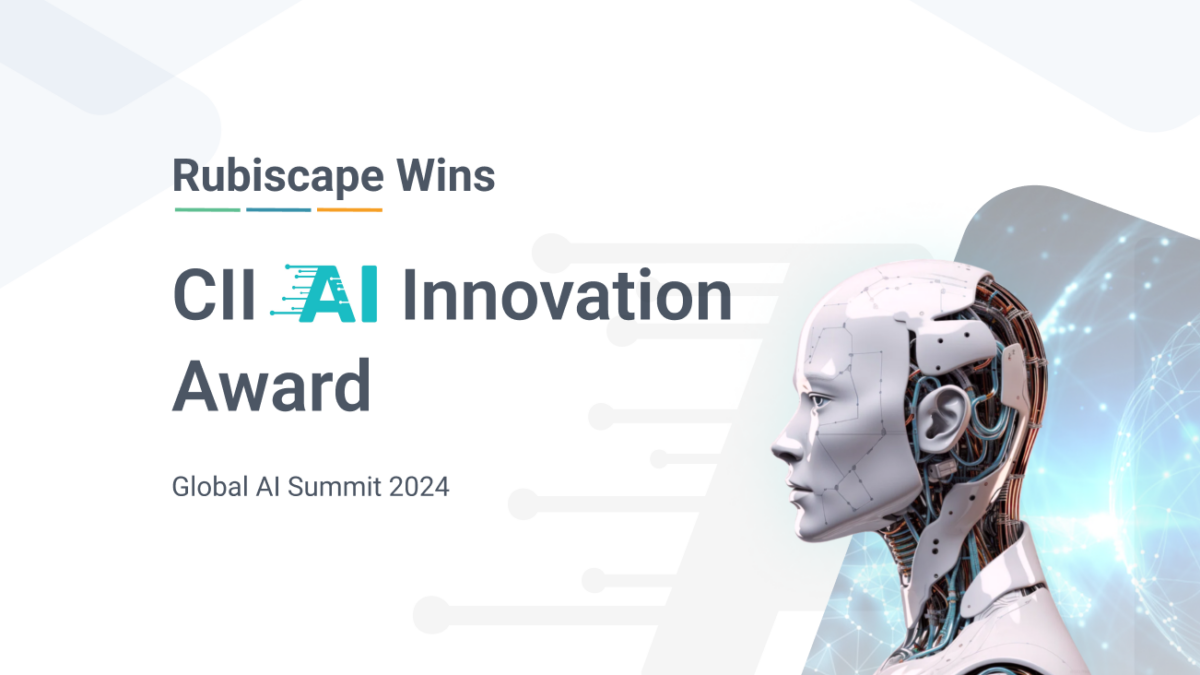
Rubiscape wins CII Innovation Award
News

CII’s National AI Innovation Award to Rubiscape

New Delhi, February 26, 2024 – Rubiscape, a Pune-based and India’s one of the first Data Science & Machine Learning (DSML) software product company, was recognized at CII’s National AI Summit with – the prestigious “Award of Merit for Excellence in Best AI Technology Product Start-up” at the 9th International Conference on Artificial Intelligence (AI) held in New Delhi on February 26th, 2024. India, being a fast-growing economy is set to lead the AI revolution and is emerging as a key destination for AI innovation. There is a strong need for a strategic approach and dialogue on similar lines to connect the Indian industries especially the large numbered MSMEs, start-ups, research institutes, academia, and government as well. Towards taking India forward in AI, the Confederation of Indian Industry (CII) constituted the CII AI Forum in 2019. The theme of the conference was ‘Responsible AI for Accelerated Growth in India’ and was supported by the Ministry of Electronics and Information Technology, National Small Industries Corporation, Ministry of Micro, Small & Medium Enterprises, Office of the Principal Scientific Adviser to Government of India, and Department of Science and Technology, Government of India. Rubiscape’s “Award of Merit” underscores the company’s commitment to developing cutting-edge, indigenous AI & Data Science Software. “We are incredibly honoured to receive this recognition from CII’s AI Forum, ” said Dr Prashant Pansare, Founder of Rubiscape. “AI has the potential to revolutionize numerous sectors and has an estimated potential of $15 trillion economic boost through AI applications. India also is well poised to become a global AI talent supplier, as well as transform the government, public sector and education sectors.”  He further emphasized that “there is an immediate need for local and low-cost innovations using AI technology. We are excited about the opportunities for Made in India products and technologies for co-innovation and co-creation. We dedicated the CII-AI award to India’s Atmanirbhar Bharat movement, for being vocal for local.”  About Rubiscape Incorporated in 2020 under Govt of India’s Digital Start-up Program (DIPP), Rubiscape has emerged as a fast-growing software product company with its award-winning and truly indigenous multi-persona Data Science & Machine Learning (DSML) platform. Many forward-thinking Fortune Companies, Public Sector Enterprises, as well as leading Institutions run Rubiscape for their analytics initiatives – from Customer Experience to Climate Change and Video Analytics to Demand Forecasting. Rubiscape enables enterprises and institutions to establish AI & Data Science Centre of Excellence for Future Skilling & Innovation Incubation.

Scroll to Top